Art Deco Architecture Explained: The Style That Sold the Machine Age
Art Deco turned skyscrapers, cinemas and factories into advertisements for modern life. Six buildings — from the Chrysler Building to Mumbai and Napier — show how geometry, new materials and sheer confidence built the first truly global style.
By World Arch Journal ·
Project file
- FORMAT: International architectural history guide
- PERIOD: 1920s origins to 1930s peak; revival from the 1960s
- BUILDINGS: 6 documented international case studies
- PUBLISHED: 22 October 2026
- EDITORIAL LEAD: World Arch Journal
- VISUAL MIX: 7 licensed photographs · 1 original diagram
Art Deco is the architecture of a world in a hurry. Between the two world wars it dressed skyscrapers, cinemas, ocean liners, factories and suburban houses in the same confident language: stepped silhouettes, sunbursts, zigzags, polished stone, stainless steel and neon. It was the first style to be truly global — designed in Paris, perfected in New York, and rebuilt within two decades in Miami, Mumbai, Napier and Shanghai — and the first to understand that a building could be an advertisement for the modern life happening inside it.
Unlike the movements that followed, Deco never issued a manifesto. It was a shared instinct rather than a doctrine: that the machine age deserved ornament, that geometry could be glamorous, and that new materials — aluminium, plate glass, stainless steel, early plastics — should be shown off rather than hidden. This guide reads the style through six documented buildings. Each one isolates a different part of the language: the skyscraper crown, the streamlined hotel, the tropical cinema, the rebuilt town and the factory as billboard. It is part of our Architectural History & Styles archive, where every movement is read through real buildings and licensed photographs.
What Art Deco is — and where the name came from
The name is shorthand for the Exposition Internationale des Arts Décoratifs et Industriels Modernes, the great Paris exhibition of 1925 that presented the style to the world. Ironically, “Art Deco” was not used at the time — contemporaries said style moderne or, in America, “modernistic”. The label only stuck in the 1960s, when historians such as Bevis Hillier revived it for a style that post-war taste had dismissed as frivolous.
The roots reach back before the First World War: the crisp, geometric classicism of Auguste Perret’s Théâtre des Champs-Élysées in Paris (1913), the shock of Cubism, the saturated colours of the Ballets Russes, and a fascination with the ancient world — Tutankhamun’s tomb, opened in 1922, sent Egyptian motifs through jewellery, graphics and buildings within months. Aztec temples, Mayan pyramids and African sculpture supplied more stepped and zigzag forms. Deco absorbed all of it and machined it smooth.
Two phases are worth separating. The Parisian Deco of the 1920s was luxurious and craft-based: rare woods, lacquer, ivory-toned stone and hand-worked metal for wealthy clients. The American Deco of the crash years was bolder and cheaper — bigger, more repetitive, executed in brick, terracotta and cast aluminium — and after 1933 a streamlined variant, its corners rounded and its ornament flattened, carried the style through the Depression. Art historians call that late phase Streamline Moderne; the buildings in this guide move between the two.
Timeline: from a Paris fair to a world style
- 1913 — Théâtre des Champs-Élysées, Paris: early Deco geometry in concrete and marble.
- 1922 — Tutankhamun’s tomb is opened; Egyptian ornament becomes an international craze.
- 1925 — The Paris Exposition des Arts Décoratifs showcases the style to millions.
- 1929–31 — New York’s skyscraper race: the Chrysler Building (1930) and Empire State Building (1931).
- 1931 — An earthquake destroys Napier, New Zealand; the town is rebuilt in Deco.
- 1930s — Miami Beach hotels, Mumbai’s Deco ensembles and London’s Hoover Building spread the style across three continents.
- 1945 — Post-war taste turns against Deco; demolitions follow in the 1950s and 1960s.
- 1968 — Bevis Hillier’s book popularises the name “Art Deco”; revival and preservation campaigns begin.
- 1979 — Miami Beach’s Art Deco district is listed on the US National Register of Historic Places.
- 2018 — UNESCO inscribes Mumbai’s Victorian Gothic and Art Deco Ensembles as a World Heritage Site.
How to recognise an Art Deco building
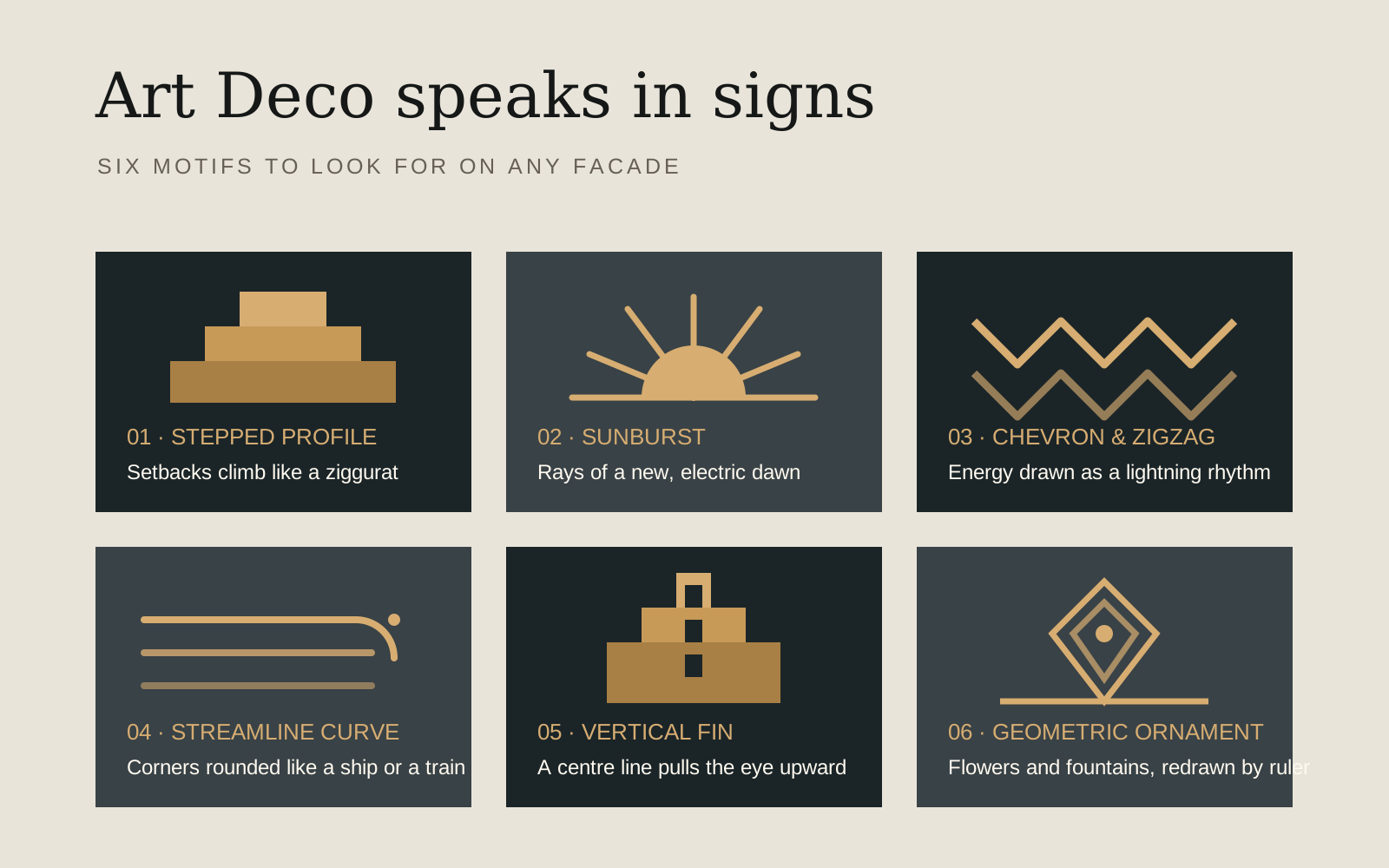
Six signs, used together, identify Deco more reliably than any single motif. First, a stepped profile: masses rise in setbacks like a ziggurat, often because zoning laws — New York’s 1916 code above all — forced tall buildings to step back from the street, and architects turned the legal requirement into the style’s silhouette. Second, sunbursts and radiating patterns, carved over doors, cast into grilles and tiled into floors. Third, chevrons, zigzags and lightning bolts — energy drawn as ornament.
Fourth, streamlining: after about 1933, corners curve, horizontal bands wrap around buildings like the decks of a ship, and porthole windows and “eyebrow” canopies appear, especially in Miami. Fifth, a vertical fin or emphasised centre line that pulls the eye upward — the opposite of the classical horizontal cornice. Sixth, stylised nature: flowers, fountains, gazelles and human figures redrawn with a ruler into flat geometric emblems, often in relief panels of stone, terracotta or metal.
Two cautions keep the identification honest. Symmetry and rich material alone do not make a building Deco — stripped classical and moderne buildings share the period. And ornament is applied to a modern frame: behind the zigzags there is almost always a steel or concrete structure, a lift core and a plan organised for offices, cinemas or hotels. Deco is modern construction wearing ceremonial dress, not a revival of handcraft building.
Materials of the machine age
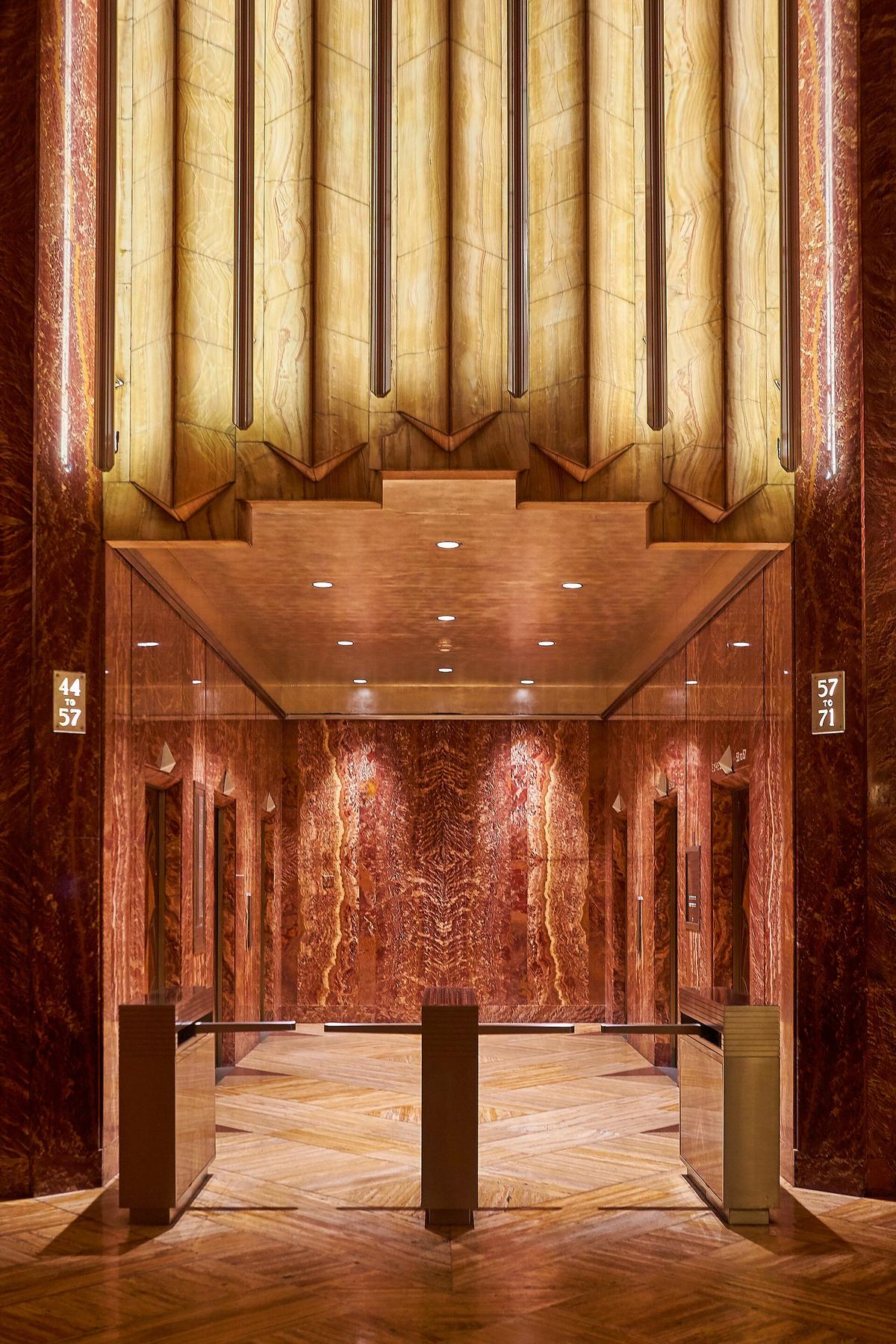
Deco’s material palette mixed the ancient and the industrial without embarrassment. Polished marble, onyx and travertine lined lobbies — the Chrysler Building’s elevator hall wraps book-matched onyx and red marble around African wood marquetry — while stainless steel climbed outside: the Chrysler crown is clad in Nirosta stainless steel, chosen because it would never need painting at 300 metres. Between them sat the new manufactured surfaces: aluminium spandrels and doors, black Vitrolite glass panels, glass block, terrazzo floors, cast terracotta and faience, and neon, which turned signs into architecture after dark.
The point was not luxury for its own sake. Each material advertised a virtue — hygiene, speed, permanence, electric light. A cinema in white stucco and neon promised modern pleasure; a factory in glazed faience promised modern cleanliness. Reading a Deco building means reading its surfaces as claims, then checking whether the plan and structure live up to them. Our materials library documents how several of these surfaces — including travertine, the pale stone of Deco lobbies and Roman precedent alike — are specified and finished today.
1. Chrysler Building, New York: the crown as a corporate jewel
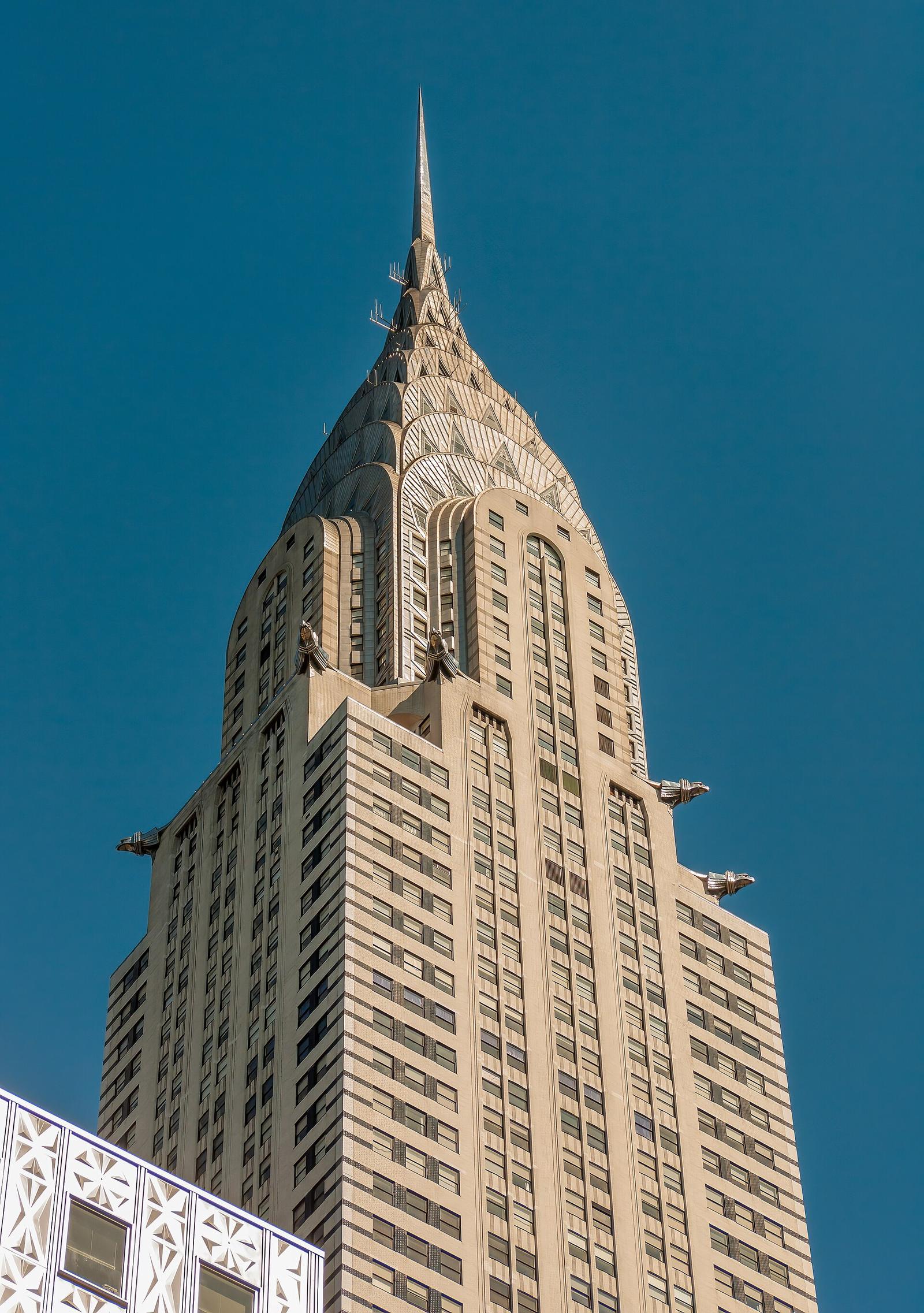
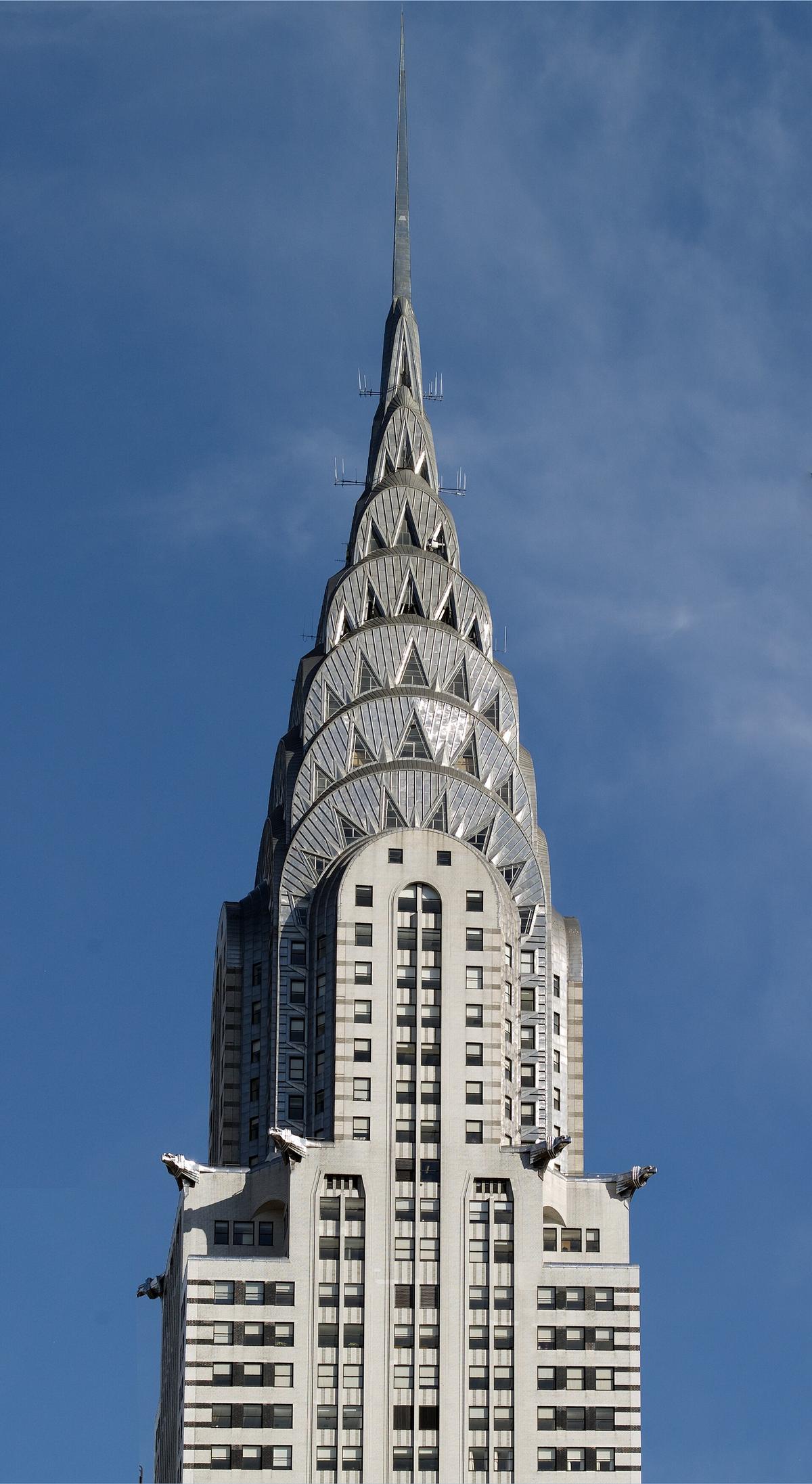
William Van Alen designed the Chrysler Building for car magnate Walter Chrysler, and it remains the style’s most joyful skyscraper. Completed in 1930, it rises 319 metres through a white-and-grey brick shaft to a terraced crown of stainless steel, pierced by triangular windows and stacked sunburst arches. At the setbacks, steel eagles — enlarged from 1929 Chrysler bonnet ornaments — lean over the street. The building is a car company’s mythology translated into architecture.
Its most famous detail is theatrical. Van Alen’s rival H. Craig Severance was completing 40 Wall Street across town, and the title of world’s tallest building hung on metres. The Chrysler’s spire — a 56-metre “vertex” — was assembled secretly inside the crown and hoisted through it in October 1929, taking the record in a single morning. The Empire State Building seized the title eleven months later, but the Chrysler kept the better silhouette; New York’s Landmarks Preservation Commission designated it a landmark in 1978.
The lesson for designers is that the decoration is structural theatre, not icing. The crown’s terraces follow the zoning setbacks; the eagles mark the corners where the mass steps; the spire completes a vertical argument the whole building has been making. Ornament, silhouette and corporate story are one move.
2. Empire State Building, New York: Deco at full scale
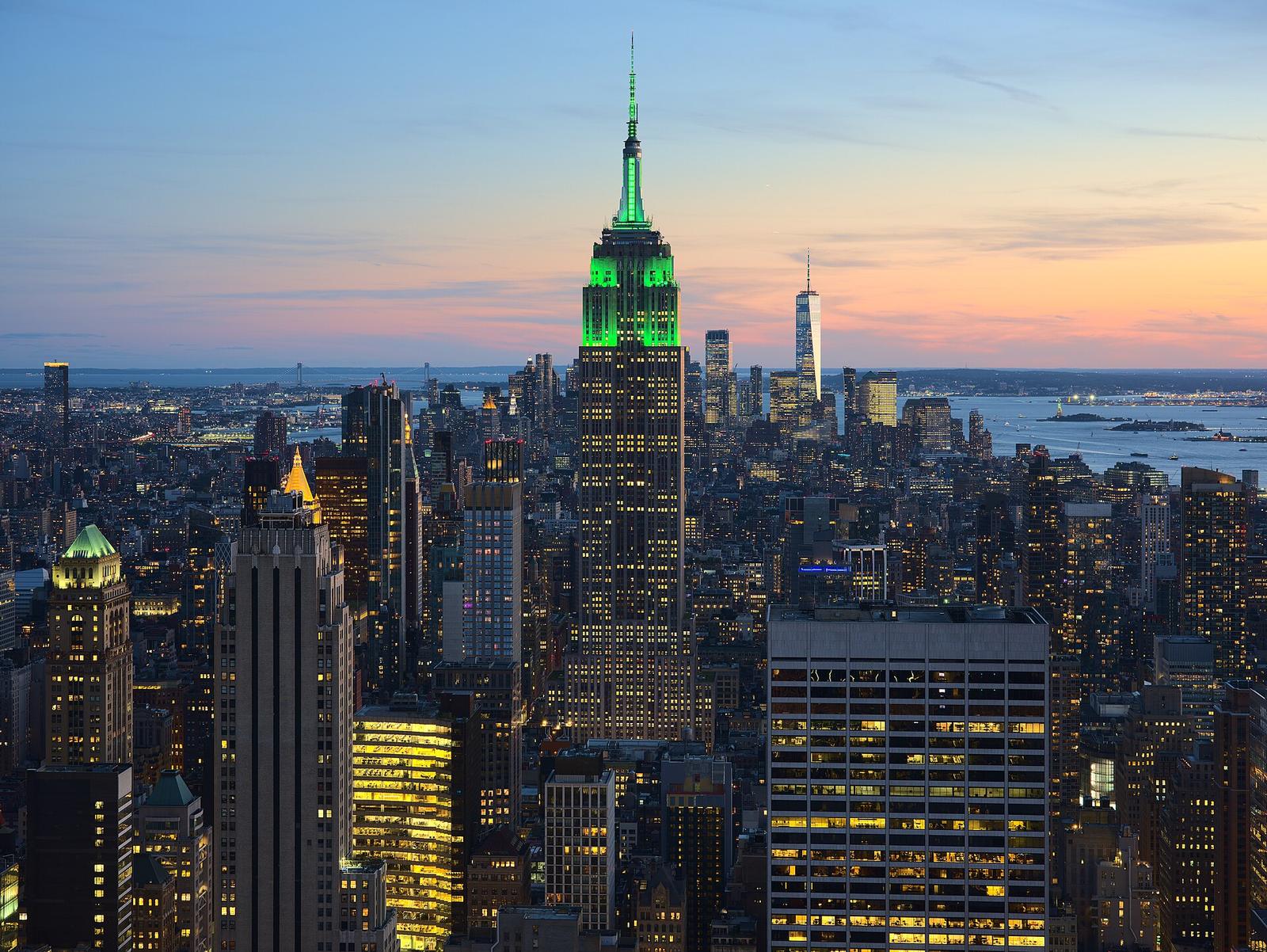
Where the Chrysler is jewellery, the Empire State Building — Shreve, Lamb and Harmon, opened 1 May 1931 — is Deco as logistics. Built in thirteen and a half months in the depths of the Depression, it rose to 381 metres (443 metres to the tip) and held the world height record for four decades. Its massing is the 1916 zoning envelope drawn honestly: a five-storey base, then a limestone shaft stepping back to a mooring mast originally intended for airships.
The decoration is deliberately restrained — Indiana limestone, granite and aluminium spandrels, with ornament concentrated in the entrances and the marble lobby, restored in 2009 with its aluminium-and-gold ceiling mural. Critics sometimes call the building “barely Deco”, but that restraint is the point: at this scale the style becomes rhythm and proportion — vertical piers, repeated windows, setbacks catching light — rather than applied motifs. It proved Deco could organise the largest office building on earth without losing its ceremonial charge.
3. Miami Beach: Deco turns tropical
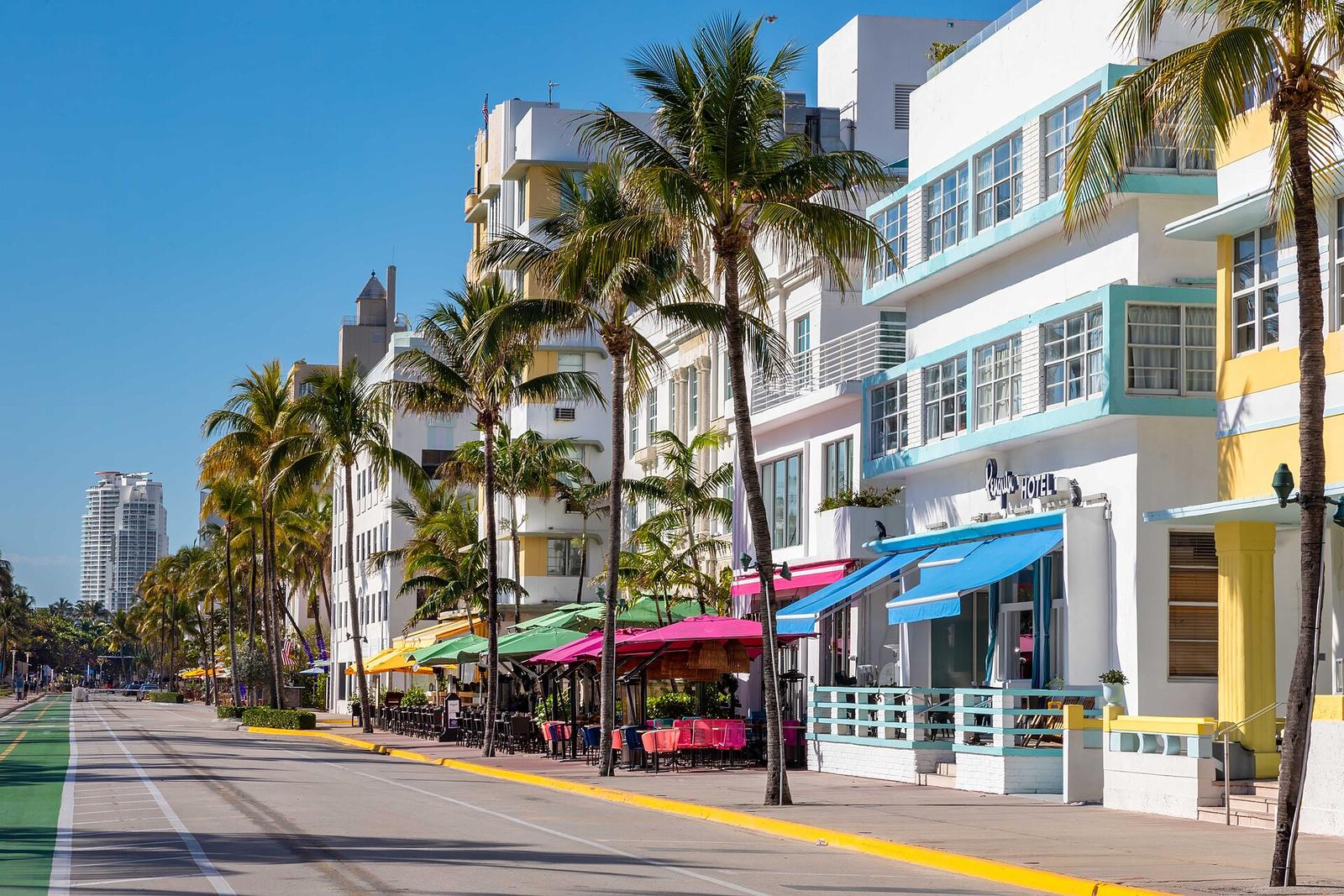
Miami Beach holds the style’s happiest chapter: hundreds of small hotels and apartment buildings raised along Ocean Drive and Collins Avenue in the 1930s and early 1940s by architects such as Henry Hohauser and L. Murray Dixon. Built cheaply in stucco over concrete for the winter tourist trade, they translated New York glamour into a tropical dialect — pastel colours, rounded corners, “eyebrow” window shades, portholes, neon signs and central fin-signs carrying the hotel’s name like the prow of a ship.
The district nearly vanished in the 1970s, when elderly residents and demolitions defined the beach. Barbara Baer Capitman’s Miami Design Preservation League campaigned to list it, and in 1979 the Miami Beach Architectural District became the first twentieth-century district on the US National Register — around 800 Deco and period buildings protected. The preservation victory matters beyond Florida: it was the moment Art Deco stopped being disposable nostalgia and became heritage with legal standing.
4. Mumbai: an ocean away, a style at home
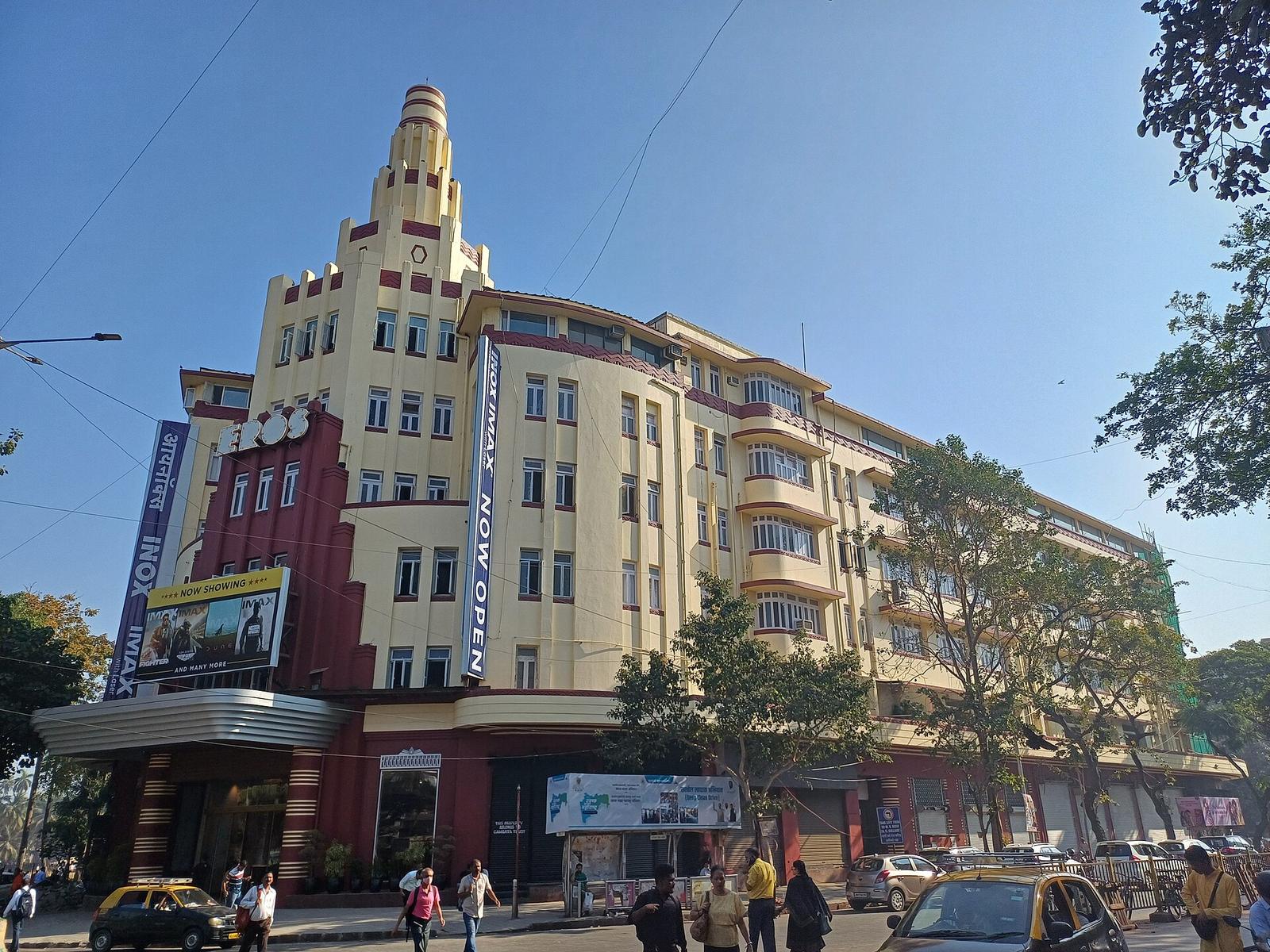
Mumbai — then Bombay — built more Deco than almost anywhere outside Miami, and UNESCO’s inscription of its Victorian Gothic and Art Deco Ensembles in 2018 recognised the largest such collection in India and one of the largest in the world. Around the Oval Maidan and along Marine Drive, Indian architects and patrons raised apartment houses, offices and cinemas in the 1930s and 1940s: curved corner balconies, frozen-fountain motifs, tropical lettering, and ornament that quietly absorbs Indian imagery — peacocks, lotus forms, even ocean liners — into the Deco grammar. Scholars call the blend “Indo-Deco”.
The Eros Cinema (1938), designed by Sohrabji Bhedwar for the Cambata family, is its monument: a cream-and-maroon ziggurat tower over a streamlined cinema block, part of the Churchgate ensemble facing the Maidan. Mumbai’s Deco was not colonial copy-work; it was commissioned by Indian merchants, designed largely by Indian architects, and it housed a new urban middle class. That is why the style’s global story cannot be told from Paris and New York alone.
5. Napier: the town an earthquake redesigned
On 3 February 1931 the Hawke’s Bay earthquake levelled the commercial centre of Napier, New Zealand. The rebuilding, executed in a few years in reinforced concrete, adopted the modern styles of the moment — Art Deco, Stripped Classical and Spanish Mission — giving a small port town an improbably complete 1930s streetscape. Speed and safety drove the choice: concrete resisted fire and tremors, and flat ornamented facades could be built fast by local firms.
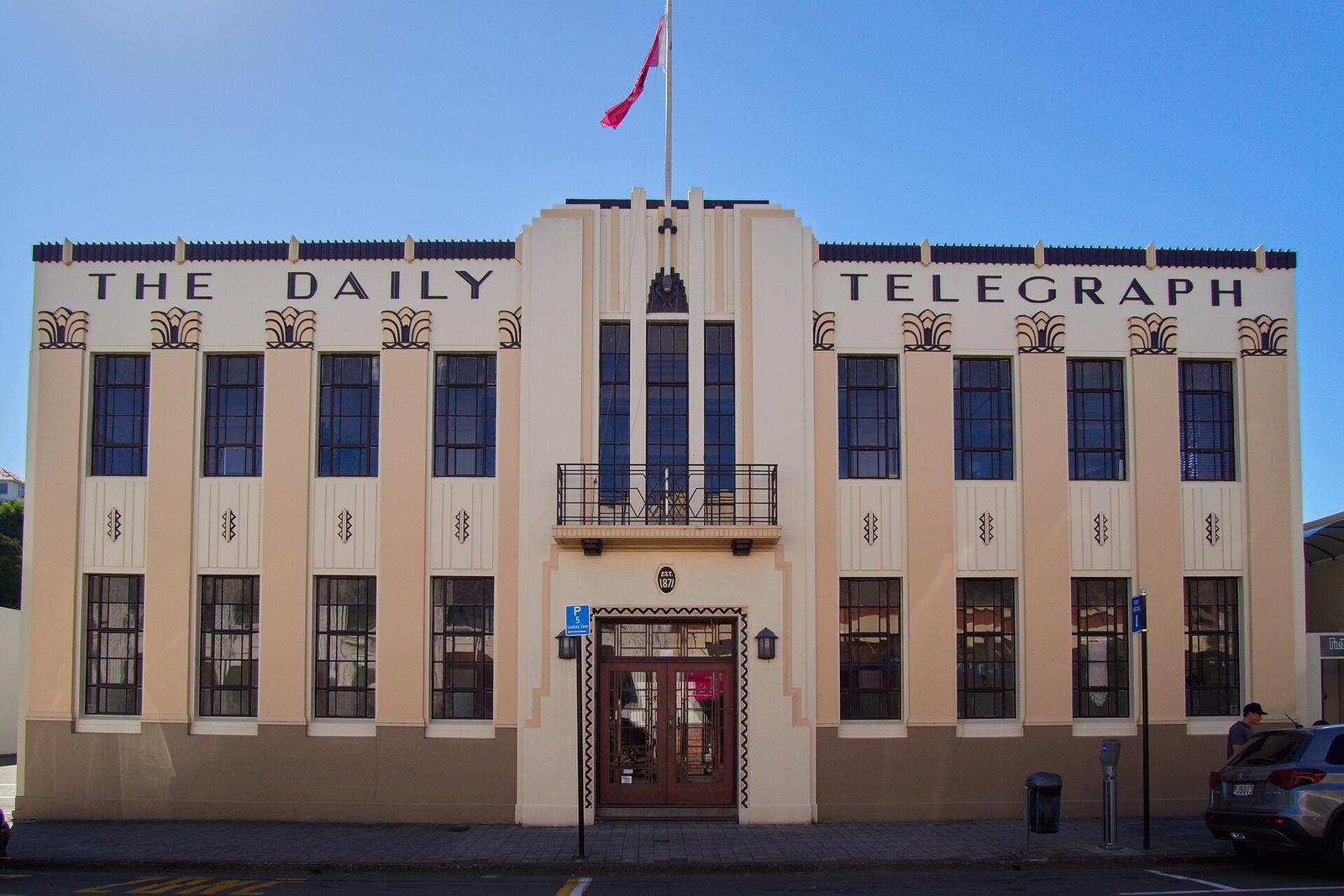
The Daily Telegraph Building (1932, by E. A. Williams) shows the formula at its purest: a symmetrical stucco facade, sunburst capitals, zigzag spandrel panels and the newspaper’s name in Deco lettering, all executed in painted render rather than stone. Napier’s Art Deco Trust, founded in 1985, turned the accident of survival into stewardship, and the town’s annual Deco festival now funds the unglamorous work — paint, render, seismic care — that keeps a whole town’s style alive.
6. Hoover Building, London: Deco goes to work
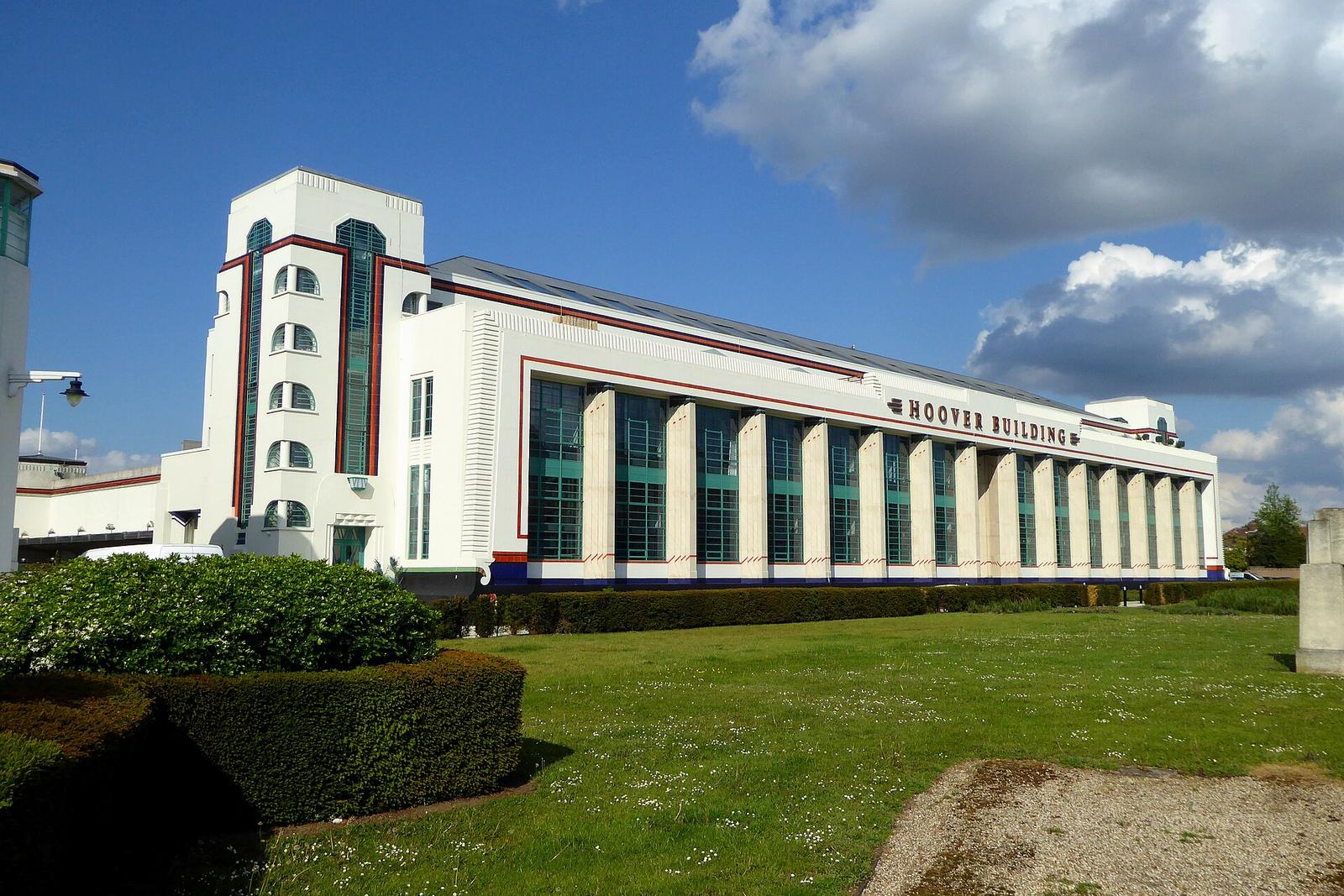
Britain’s exuberant Deco is mostly found not in offices but in the “Byzantine” factories of the arterial roads — and the Hoover Building in Perivale, west London (Wallis, Gilbert and Partners, opened 1933), is the masterpiece. Built for the Hoover vacuum-cleaner company, its long white facade — Portland stone, coloured faience and glass, with Egyptian-flavoured detail around the windows — was quite deliberately a billboard: motorists on the Western Avenue read modern cleanliness in its shining surfaces before they read the name.
The building’s afterlife is equally instructive. Production ended in the 1980s; the main building, listed Grade II*, was converted to apartments in a restoration completed in 2018 that kept the facade’s colour and lettering intact. Deco’s critics once called such factories vulgar advertising. The Hoover Building makes the counter-case: advertising, done with this much craft, becomes civic architecture.
One style, many accents
Deco’s global spread produced dialects, not copies. In Paris it stayed close to luxury craft — the Palais de Tokyo and the great department stores favour stone, bronze and sculpture over size. In Shanghai, the Peace Hotel (1929, then the Cathay) and the Broadway Mansions fused Deco with the treaty-port skyline. Tel Aviv absorbed Deco and International Style together into its White City of curved, white, pilotis-lifted apartment houses. Durban wrapped Deco around a subtropical port; Havana and Los Angeles poured it into theatres and hotels; Jakarta and Manila used it for the civic buildings of late-colonial capitals.
The comparison teaches a method. Wherever Deco travelled, it negotiated with climate, craft traditions and local symbols — eyebrows against tropical sun in Miami, deep verandas and local motifs in Mumbai, stucco speed in Napier. The style that looks most international is, at street level, a record of local adaptations. That is also why it survives photography so well: every city’s Deco is recognisably itself.
Decline, demolition and the Deco revival
After 1945, Deco was condemned by association — with the Depression, with commerce, with ornament itself. The International Style’s white grids defined serious modernism, and Deco masterpieces fell: New York and London lost theatres, hotels and factories through the 1950s and 1960s. The revival began as scholarship — Hillier’s 1968 book named the style — and became a movement when Miami’s activists proved that listing could save whole districts. Napier’s trust, Mumbai’s conservationists and UNESCO’s 2018 inscription extended the argument across three more continents.
Preservation has its own Deco problem: the style lives in its surfaces. Neon, faience, coloured stucco, metal windows and signage are exactly the elements maintenance budgets cut first, and a Deco building stripped of them is a diagram of itself. The successful cases in this guide — the Empire State’s lobby restoration, the Hoover Building’s conversion, Napier’s town-wide care — share one trait: the ornament was treated as the architecture, not as a dispensable extra.
Compare the next chapter of the story in our guide to Brutalist architecture, where concrete replaced polish and the argument about ornament began again. Deco’s own lesson is simpler and still radical: a building may sell, celebrate and symbolise — and still be serious architecture, if its makers take the selling as seriously as the structure.
Continue exploring: browse the full Architectural History & Styles archive for more movements read through their buildings, or step from history into the materials library to see the stones, metals and finishes that these facades were made from.
From the library: Go deeper: Art Deco — A Complete History (Book VIII), free to read online — the World Arch Journal book on the movement, with the buildings in this guide set in their full story.
Frequently asked questions
What are the key characteristics of Art Deco architecture?
Stepped setback silhouettes, sunburst and radiating patterns, chevrons and zigzags, streamlined curves in the later phase, strong vertical emphasis, and stylised geometric ornament in stone, metal, glass and terracotta — applied to modern steel or concrete frames.
How can you recognise an Art Deco building?
Look for at least three of the six signs together: a stepped profile, a sunburst over the entrance, zigzag ornament, rounded streamline corners, a central vertical fin, and flat geometric relief decoration. Rich materials alone are not enough — stripped classical buildings of the same years share the polish without the motifs.
Which are the most famous Art Deco buildings?
The Chrysler Building and Empire State Building in New York, the Ocean Drive hotels of Miami Beach, the Eros Cinema and Marine Drive ensembles in Mumbai, the rebuilt centre of Napier in New Zealand, and the Hoover Building in London are the canonical examples covered in this guide.
What materials are used in Art Deco buildings?
Polished marble, onyx and travertine in lobbies; stainless steel and aluminium outside; black glass (Vitrolite), glass block and terrazzo; cast terracotta and faience facades; stucco in the tropical variants; and neon for signs. The mix of ancient stone and industrial metal is itself a Deco signature.
What is the historical significance of Art Deco?
Art Deco was the first truly global architectural style and the first designed for the age of mass media, cinema and the motor car. It proved ornament and modern construction could coexist, shaped the identity of cities from New York to Mumbai, and its preservation battles in Miami, Napier and Mumbai helped define modern heritage practice.
How did Art Deco influence modern architecture?
It normalised the setback skyscraper silhouette, integrated signage and lighting into architecture, advanced metal-and-glass facade technology, and carried modern design to suburbs and small towns that modernism never reached. Post-war modernism reacted against its ornament, but contemporary architecture has re-adopted its confidence in colour, pattern and symbolic form.
Evidence and source notes
- Victoria and Albert Museum — Provides the museum overview of Art Deco’s origins, the 1925 Paris exhibition and the style’s global spread and materials.
- UNESCO World Heritage Centre — Documents the Victorian Gothic and Art Deco Ensembles of Mumbai, their 2018 inscription and the significance of the Eros Cinema and Oval Maidan ensembles.
- Encyclopaedia Britannica — Documents the Chrysler Building’s architect, date, height and its brief tenure as the world’s tallest building.
- Empire State Building (official) — Documents the building’s architects, 1931 opening, construction speed and record height.
- Miami Design Preservation League — Documents the Miami Beach Art Deco Historic District, its preservation campaign and 1979 National Register listing.
- Art Deco Trust, Napier — Documents Napier’s 1931 earthquake rebuilding, its Art Deco building stock and the Trust’s stewardship since 1985.
- Wikimedia Commons — Seven editorial photographs are used with named authors, source pages and open-licence terms retained in every caption.
Related architecture stories
- Brutalist Architecture Explained: 7 Buildings That Make the Case
Brutalism is not simply raw concrete or an Instagram mood. Seven buildings show how material honesty, structure, circulation and public ambition produced radically different architectures.
- Frank Lloyd Wright: Organic Architecture, Landmark Works and the Houses You Can Still Visit
Fallingwater, the Robie House, the Guggenheim spiral: a clear guide to Frank Lloyd Wright's organic architecture, his landmark works from the Prairie houses to the Usonians — and the Wright buildings you can still visit today.
- Loft Conversion Handbook: Types, Headroom, Stairs, Planning and Costs
Most UK pitched-roof houses can gain a loft room, but only when ridge height, roof structure and a compliant stair all line up at once.
📌 Never miss a story — add World Arch Journal as your preferred source on Google: https://www.google.com/preferences/source?q=worldarchjournal.com