AI in Architecture 2026: Adoption, Risks and New Rules
AI has moved from experiment to everyday architectural work. The competitive question is no longer whether a practice uses it, but whether speed is matched by judgement, disclosure and accountable review.
By World Arch Journal ·

Project file
- FORMAT: International practice analysis
- EVIDENCE: RIBA 2026 · Chaos 2026 · EU AI Act
- AUDIENCE: Architects, studios, clients and design students
- PUBLISHED: 5 October 2026
- EDITORIAL LEAD: World Arch Journal
- VISUAL MIX: 4 licensed real photographs · 4 original diagrams
AI in architecture means using machine-learning systems to assist design work — summarising meetings, generating early imagery, searching precedents, classifying information and exploring options — while architects keep authorship and professional responsibility. By 2026 the tools are ordinary: RIBA reports 74% of surveyed UK practices use AI on at least some projects. The dividing line between practices is no longer adoption, but governance.
Artificial intelligence is no longer a side experiment in architecture. It is being used to summarise meetings, draft text, organise precedents, generate early imagery, write scripts, classify information and explore options. That does not make the technology mature, reliable or neutral. It means that practices need a clearer operating model than “try the tool and see what happens”.
The strongest 2026 evidence comes with an important boundary. The RIBA AI Report 2026 measures UK architectural practice, while the Chaos AI in Architecture Report 2026 surveys a broader but differently composed professional sample. Neither report represents every country, office size or project type. Together, however, they show the same direction: adoption is moving faster than governance.
This article is an international practice guide, not legal advice and not a prediction that AI will replace architectural authorship. It asks a more useful question: which tasks can be accelerated without allowing synthetic confidence to exceed verified knowledge?
AI in Architecture 2026: Key Takeaways
AI now assists everyday architectural work: drafting and summarising, searching precedents, testing early imagery, and organising project knowledge. It does not carry professional responsibility. Its clearest benefits are speed and breadth — more options tested early, faster retrieval from office libraries, and productivity gains reported by three-quarters of surveyed practices. Those benefits hold only where a competent reviewer checks sources, geometry, and compliance before anything is issued. The risks are equally concrete: plausible but unbuildable output, unverified code answers, confidential data leaving the studio, synthetic imagery mistaken for evidence, and junior staff losing the tasks through which judgement is learned. Human control is therefore the operating model, not an afterthought: name the decision, match the reviewer to its consequence, label synthetic content, and keep a record that reconstructs the decision. Looking ahead, the practices that gain most will not hold the most subscriptions, but those that govern the tools, protect early-career learning, and keep authorship, evidence, and duty of care intact.
The 2026 tipping point
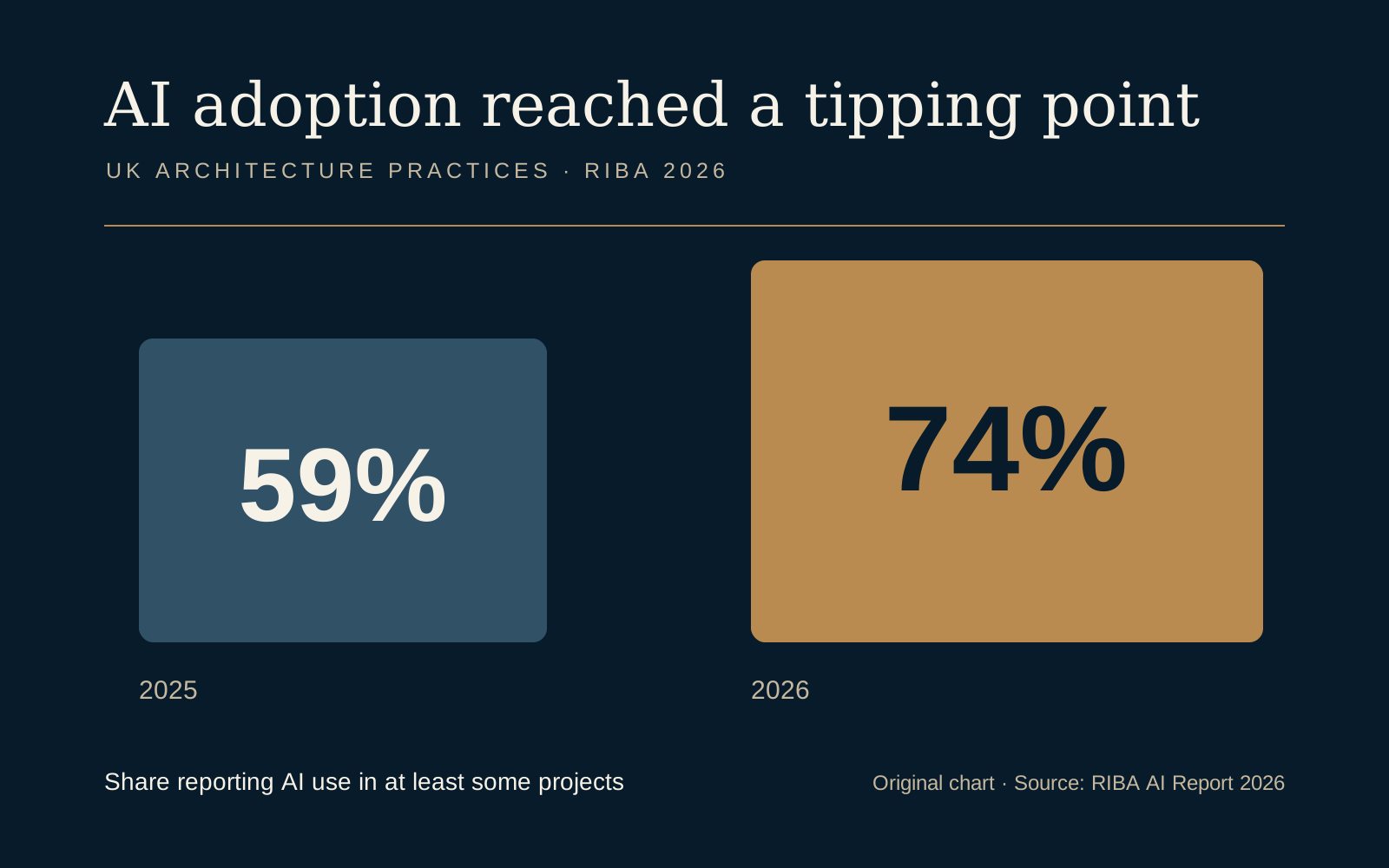
RIBA reports that 74% of surveyed UK practices use AI on at least some projects, up from 59% in 2025. That fifteen-point rise matters because adoption is no longer confined to a small group of technical specialists. The tools are becoming ordinary enough to influence deadlines, staffing, client expectations and the visual language of competitions. They are also reshaping the built environment itself: the computing demand behind these systems is driving a new generation of data centre architecture, examined in our latest explainer.
Adoption is not the same as transformation. A studio using an assistant to format notes and a practice connecting models, specifications and internal knowledge are both counted as users, but they have very different capabilities and risks. Percentage alone cannot tell us whether the output improved design quality, reduced rework or merely produced more material to review.
The practical conclusion is to measure tasks, not enthusiasm. Record where AI is used, time saved, corrections required, information exposed, reviewer seniority and whether the result reached a client or statutory submission. Without that record, a practice cannot distinguish real productivity from displaced checking time.
What Does the RIBA AI Report Reveal About Architecture in 2026?
The RIBA AI Report 2026 is the institute's third annual survey of AI in architectural practice, and its largest so far. Its headline is adoption: 74% of surveyed UK practices now use AI in at least some projects, continuing a three-year climb from 41% in 2024 and 59% in 2025. But the more useful findings are about what that adoption actually delivers, and where the profession draws its lines.
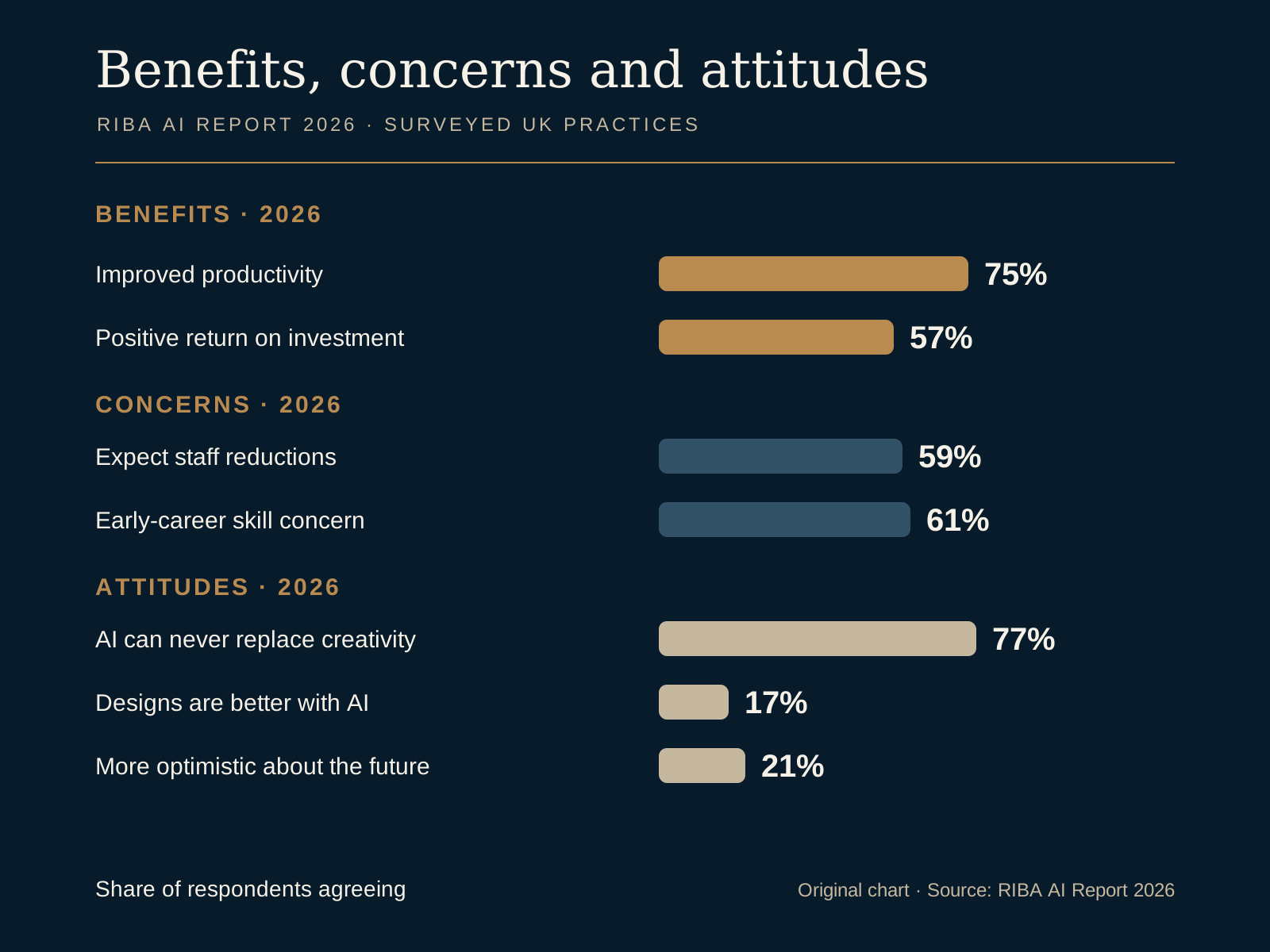
The first surprise is how uneven the payoff is. Three-quarters of respondents (75%) report improved productivity, and 57% report a positive return on investment — yet only 17% agree that their designs are better because of AI. The tools are making practices faster, not necessarily making buildings better, and the profession knows it: 77% of respondents agree that AI can never replace human creativity, and only 21% say AI makes them more optimistic about the future of their organisation.
The second finding concerns where AI is actually used. RIBA's report places it across the whole range of practice: early design-stage visualisation, project management, and the day-to-day tasks of running a business — not only image generation. That breadth explains why governance, not enthusiasm, is now the dividing line: the same tool that formats a meeting note can also produce a persuasive but unbuildable detail, and the report's own agenda reflects that tension, covering procurement decisions, ethics, inclusion and the environment, standards, business transformation, and a “people first” approach to adoption.
The third finding is about responsibility. Alongside the widely quoted expectations — 59% believing AI will lead to staff reductions and 61% fearing early-career professionals will find it harder to acquire essential skills — RIBA's position is competence-led: those responsible for critical decisions in delivering buildings should possess the specific skills, competencies and professional judgement the task requires, and design outputs delivered without professional oversight create unacceptable risks. An AI Overlay to the RIBA Plan of Work and a policy for responsible AI use are in development. For a practice, the implication is practical rather than philosophical: adoption is no longer the decision to make. The decisions are which tasks, which reviewer, which data, and which label — made before the tool is opened, not after the output arrives.
Sources: RIBA AI Report 2026; RIBA news, “AI adoption reaches tipping point across UK architecture”.
Where AI is useful now—and where the boundary should sit
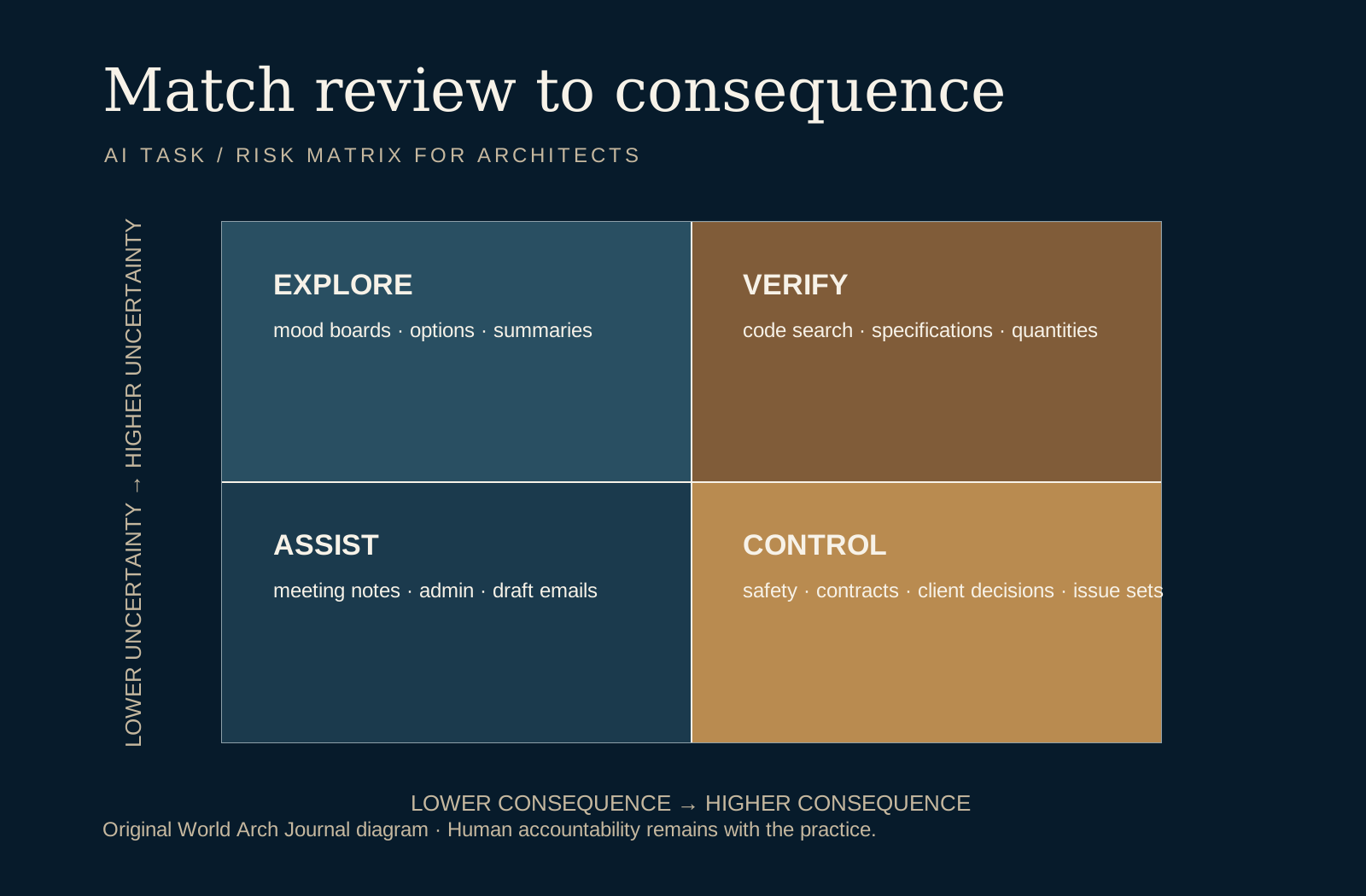
Low-consequence assistance is the simplest starting point: turning a meeting transcript into an action list, reformatting a project description, translating non-contractual text, proposing document headings or generating a first set of search terms. These tasks still need review, but an error is usually visible and recoverable.
Design exploration can widen the field of options. Image systems can test atmosphere, composition and material mood; language systems can challenge a brief or surface overlooked precedents; scripts can generate geometric variations. The output should be labelled as exploratory. An image is not evidence that a detail can be built, a material will weather as shown or a planning authority will accept the proposal.
Information retrieval may be valuable when it is grounded in a controlled library. A practice can search approved standards, office details or post-occupancy lessons more quickly, provided every answer points back to a current source. A general model answering from unknown training data is not an acceptable substitute for checking the governing code, manufacturer literature or appointment.
High-consequence work demands stronger controls. Code interpretation, fire strategy, structural decisions, accessibility, specification clauses, quantities, contracts and issued drawings affect safety, money and liability. AI can help organise questions, but a competent person must verify the source, context, version and conclusion. The more consequential the decision, the less appropriate a one-click workflow becomes.
Plausible output is not proof
Generative systems are optimised to produce a convincing continuation, not to guarantee truth. A fabricated clause number can look identical to a real one. A visual can hide an impossible span, duplicate a stair or merge incompatible materials. A summary can remove the qualification that made the original source accurate.
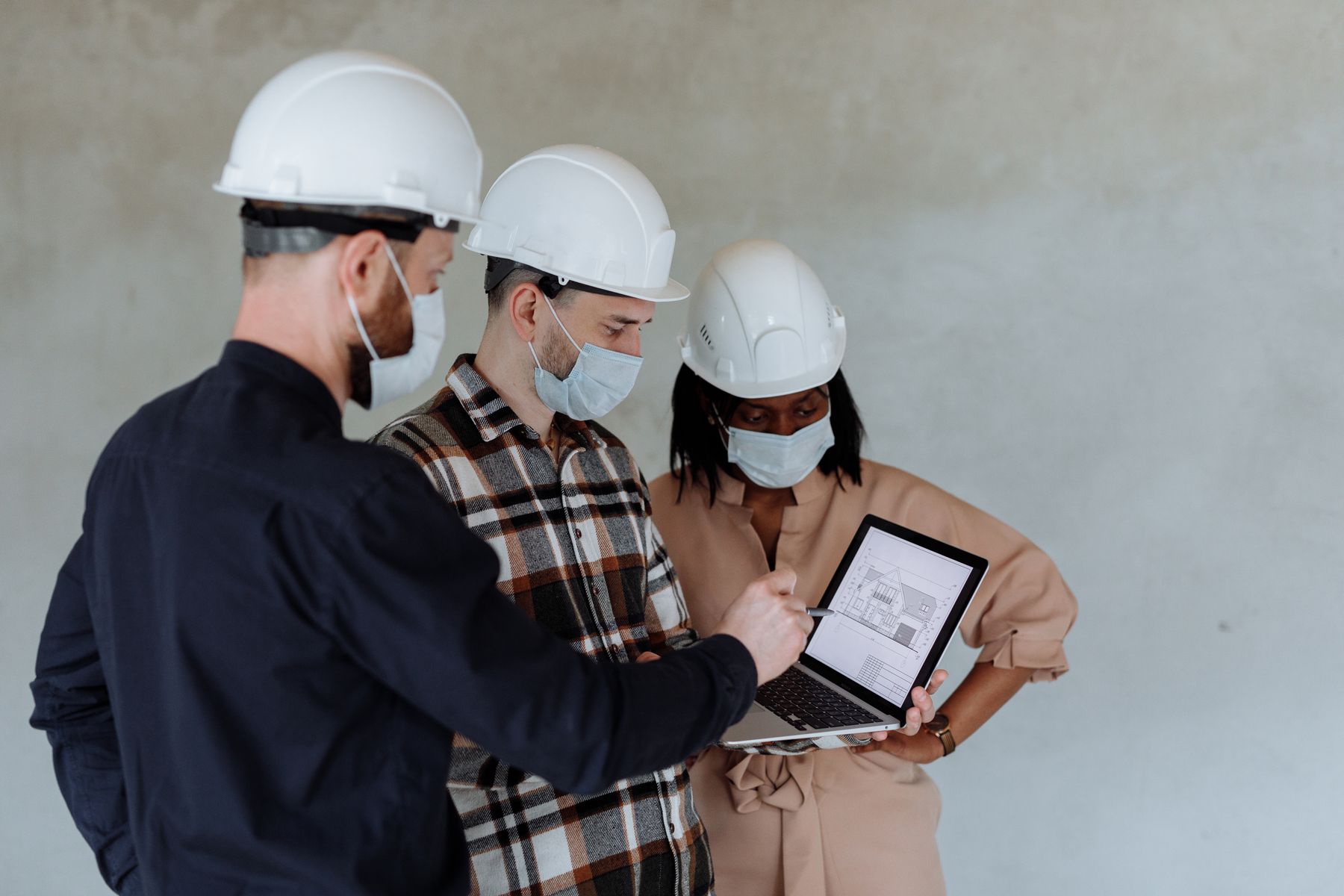
Architectural review therefore needs three layers. First, source review: can the claim be traced to a current, authoritative document? Second, spatial review: does the geometry work across plan, section, elevation and sequence? Third, professional review: is a suitably qualified person prepared to take responsibility for the decision?
These layers also apply to retrieval-augmented systems. Connecting a model to an office library reduces some uncertainty but does not remove versioning, access or interpretation errors. A superseded detail can be retrieved perfectly. Governance must cover the documents as well as the model.
The skills and workforce question
RIBA’s 2026 reporting captures a serious tension: 59% of respondents expected AI to lead to staff reductions, while 61% worried that early-career staff could acquire fewer skills. The numbers describe expectations and concerns, not a measured forecast of job losses. They are still a warning about how practices allocate learning.
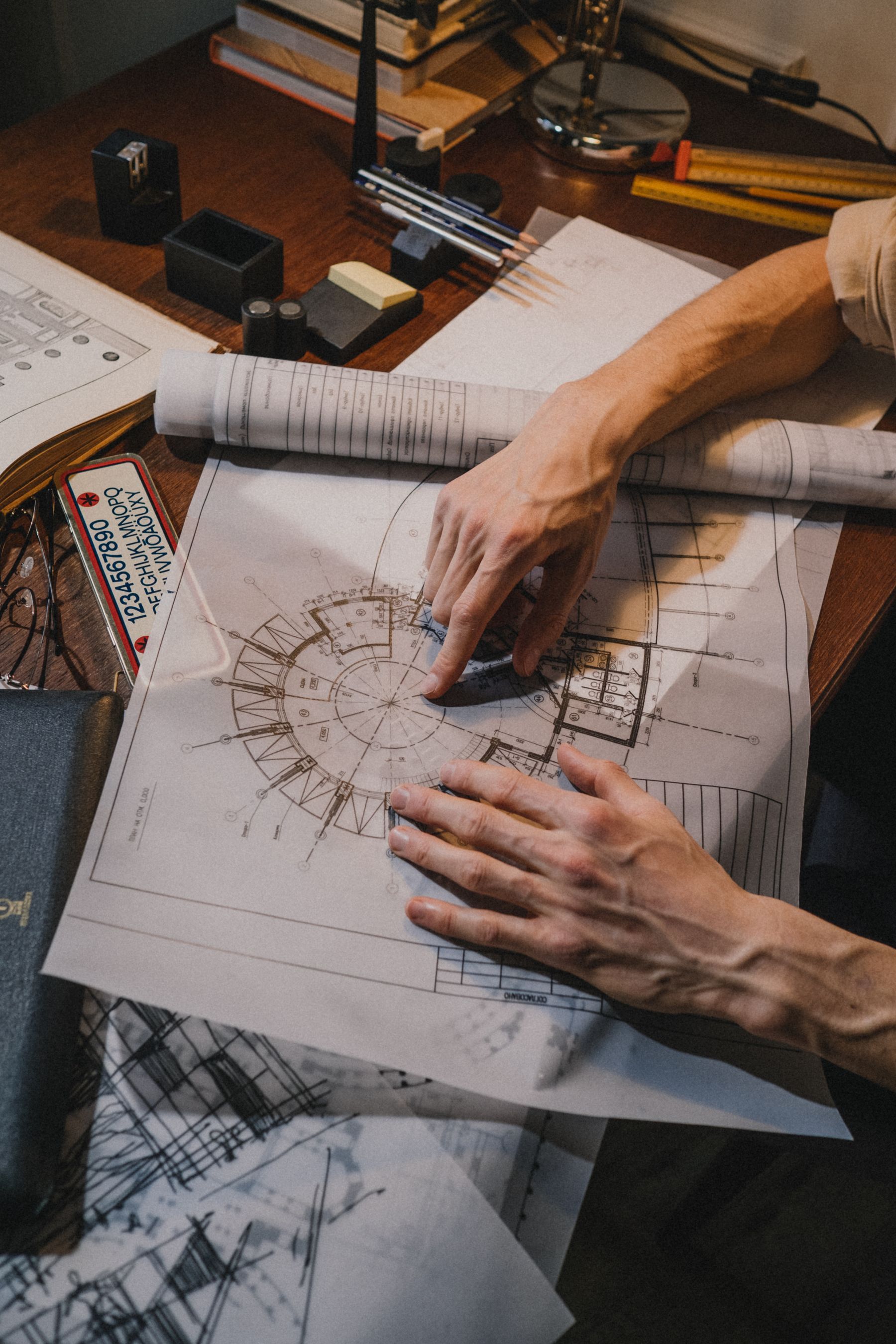
Junior work has traditionally included redlining drawings, checking schedules, assembling reports and observing how senior decisions become coordinated documents. Some of that work is repetitive; some is where professional judgement is learned. If automation removes the task but not the learning objective, the practice needs a replacement path.
A responsible office can pair every automated task with an explicit competency: compare the generated summary with the meeting recording; audit a modelled area against the brief; identify defects in a synthetic facade; trace a regulation answer to its clause and jurisdiction. AI literacy should mean knowing when not to trust the output, not simply writing a longer prompt.
Disclosure, synthetic media and the EU AI Act
Article 50 of the EU AI Act introduces transparency duties for certain AI-generated or manipulated content. The exact obligation depends on the system, content and use. Providers may need machine-readable markings; deployers of deepfake content must disclose its artificial origin; public-interest text has a qualified exception where there is human editorial review and an identified responsible person.
Architectural practice should not wait for a dispute to decide what disclosure means. A competition image, consultation visual, planning montage, marketing film and internal sketch have different audiences and consequences. Create a disclosure rule that answers four questions: Was content generated or materially altered? Could a reasonable viewer mistake it for a built fact? Does a contract or platform require a label? Who approved publication?
A simple label can protect trust: “AI-assisted concept image; unbuilt proposal; geometry and materials not technically verified.” It is more informative than a generic badge and prevents a persuasive image from being treated as construction evidence.
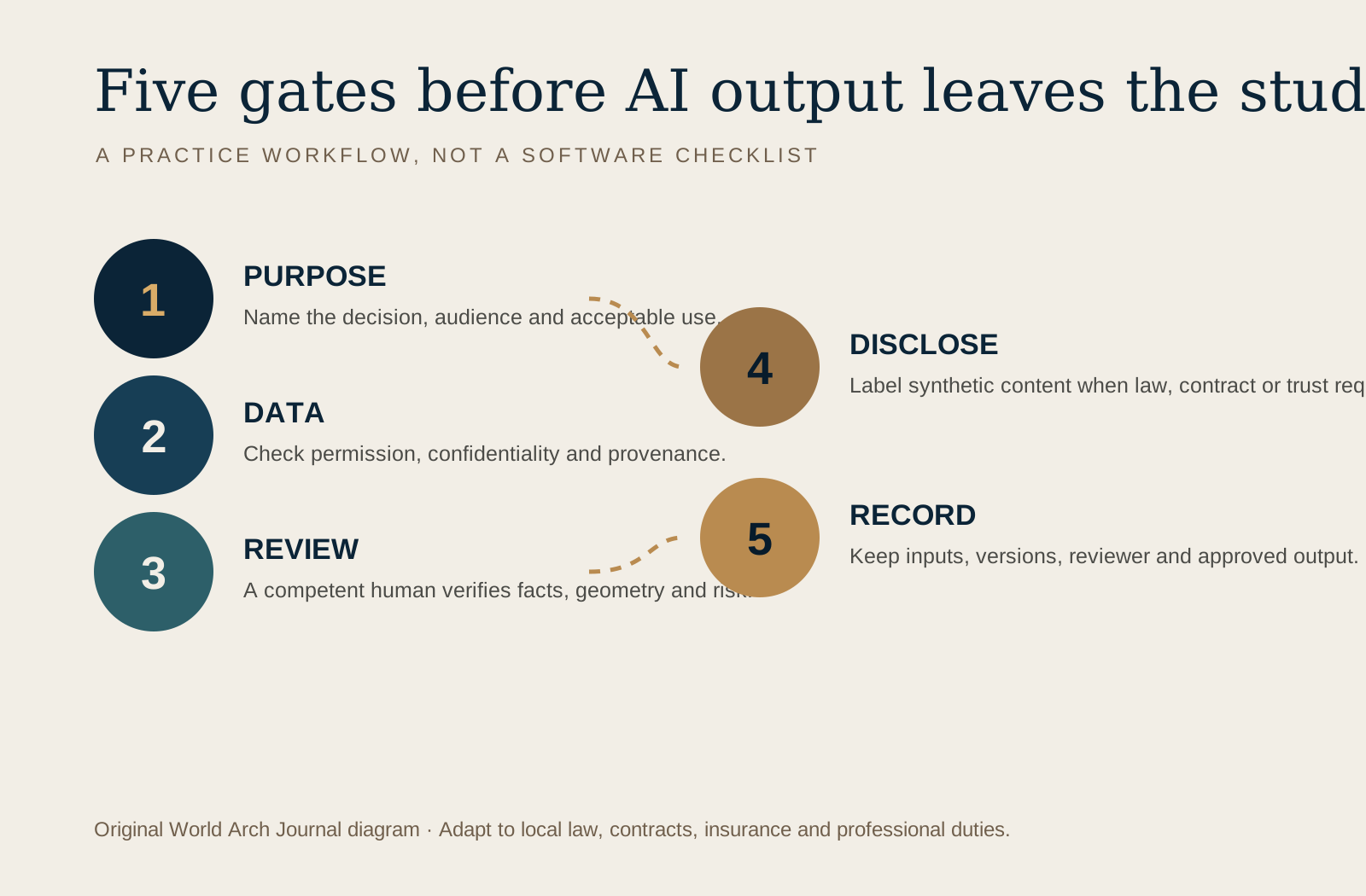
A five-gate studio workflow
1. Purpose. Name the decision, recipient and acceptable use before opening a tool. “Explore three atmospheres for an internal workshop” is safer than “design the facade”.
2. Data. Decide what information may enter the system. Client drawings, personal data, competition material and confidential contracts should not be uploaded without permission, suitable terms and a documented retention policy.
3. Review. Match the reviewer to the consequence. The author can check a social caption; a registered or otherwise competent professional must review an output that influences safety, compliance or an issued design.
4. Disclosure. Apply the studio’s label and provenance rules. Keep the distinction between a visualisation, a verified drawing and a measured result visible.
5. Record. Save the input source, tool and model version where available, prompt or instruction, output, reviewer, corrections and approved file. The record does not need to be bureaucratic, but it must make the decision reconstructable. The prompts themselves deserve the same discipline — versioned, sourced and reviewed — which is how the library of ai prompts for architects published alongside this journal is maintained.
RIBA’s analysis notes that formal policy has not kept pace with use. A one-page register and five gates are a practical first control. They should then be adapted to local law, professional regulation, insurance, cybersecurity and contractual obligations.
What clients should ask an architecture practice
| Question | Why it matters | Useful evidence |
|---|---|---|
| Where will AI be used? | Separates administrative assistance from design or compliance decisions | Task register and scope |
| Which data can enter the system? | Protects confidentiality, copyright and personal information | Approved-tool and data policy |
| Who reviews the output? | Keeps professional accountability visible | Named reviewer and sign-off route |
| How is synthetic content labelled? | Prevents concept imagery being mistaken for evidence | Disclosure standard and examples |
| Can decisions be reconstructed? | Supports quality control and dispute avoidance | Versioned record of source, output and correction |
Clients should also resist demanding AI use simply because it sounds efficient. The practice should explain the benefit for the particular project and retain the right to use a slower method when verification cost, confidentiality or design quality makes it more appropriate.
A 30-day roadmap for a small practice
Week 1: map actual use. Ask the team which tools they already use, for what tasks and with what data. Do not begin with punishment; hidden use is harder to govern than declared use.
Week 2: choose two low-risk pilots. Test meeting actions and internal knowledge search, or a similar pair. Define success before starting: minutes saved, error rate, reviewer effort and user confidence.
Week 3: write the minimum policy. List approved tools, prohibited information, mandatory review, disclosure language and recordkeeping. Include a route for exceptions.
Week 4: review evidence. Keep the pilot only if it improves the whole workflow after checking. Stop tasks that create impressive output but excessive correction, unclear rights or weak decisions.
The competitive advantage is not the largest collection of AI subscriptions. It is a practice that learns faster while keeping its evidence, authorship and duty of care intact. In 2026, speed without governance is not innovation; it is deferred risk.
Continue exploring: our 8 October briefing tracks the same shift from the software side, including Graphisoft's AI portfolio announcements and what they mean for practice. For the software foundation underneath the same question, our BIM versus CAD workflow guide separates tool capability from information responsibility.
Frequently asked questions
What is artificial intelligence in architecture?
The use of machine-learning systems to assist architectural work: drafting and summarising text, generating early design imagery, searching precedents and office knowledge, classifying information and exploring options. It describes assistance with tasks, not a replacement for professional authorship — a competent person remains responsible for every issued decision.
How many architecture practices use AI in 2026?
RIBA reports that 74% of surveyed UK practices use AI in at least some projects. The figure should not be treated as a global adoption rate.
Can architects use AI-generated images for clients or planning?
They can be useful for clearly labelled exploration, but the practice should check contracts, platform rules and local law and must not present an unverified synthetic image as built or technically resolved evidence.
Does the EU AI Act require every AI image to be labelled?
Article 50 creates transparency duties for certain synthetic or manipulated content, but the exact obligation depends on the provider, deployer and use. Obtain current legal advice for a specific workflow.
What is the safest first AI task for a small studio?
Start with a low-consequence, reversible task such as formatting internal notes, then measure correction time and keep a human reviewer.
Can AI check building codes?
It can help locate or organise questions, but the governing current code, jurisdiction and competent professional must verify the conclusion before it affects a project.
Can AI replace architects?
Not on the evidence in this article. AI accelerates tasks — notes, imagery, search, options — but it cannot take professional responsibility, verify a code conclusion, or judge whether a plausible-looking detail can actually be built. RIBA’s 2026 reporting shows expectations of staff reductions alongside worries about lost early-career learning; the practices that benefit are those that govern the tools, not those that hand over authorship.
How does AI improve sustainability in architectural projects?
Mainly by widening and speeding the option search: testing massing, orientation and material variants early, when carbon decisions are cheapest to change, and by retrieving performance evidence from project libraries. The gains are real only when a reviewer verifies the model — an unverified simulation can make an unsustainable design look efficient.
Evidence and source notes
- Royal Institute of British Architects — RIBA reports AI use by 74% of surveyed UK practices in 2026, compared with 59% in 2025.
- RIBA Journal / RIBA News — Reports 2026 outcomes and attitudes, including productivity, return on investment, creativity, optimism, and workforce expectations and concerns such as anticipated staff reductions and reduced early-career learning opportunities.
- Chaos — Provides 2026 survey evidence on professional AI uses, benefits and barriers across an internationally distributed sample.
- European Union — Article 50 establishes transparency obligations for specified AI-generated or manipulated content.
- Pexels — The four contextual photographs are used under the Pexels licence with photographer and source links retained.
Related architecture stories
- Loft Conversion Handbook: Types, Headroom, Stairs, Planning and Costs
Most UK pitched-roof houses can gain a loft room, but only when ridge height, roof structure and a compliant stair all line up at once.
- Insulating Solid Walls from Inside: Breathable Materials, Damp Risks and What It Costs
Internal wall insulation works when the wall is dry, the vapour strategy matches the masonry, junctions are detailed and ventilation is improved at the same time.
- MVHR Explained: Mechanical Ventilation with Heat Recovery for Healthy, Efficient Homes
How MVHR works, when it earns its cost, and the design details that decide whether yours is silent and effective or noisy and disappointing.
📌 Never miss a story — add World Arch Journal as your preferred source on Google: https://www.google.com/preferences/source?q=worldarchjournal.com