30 September: Measure, Reuse, Belong
A carbon benchmark, an existing house and two student proposals reveal three different ways to ask whether a design creates lasting value.
By World Arch Journal · Published · Download PDF ↓
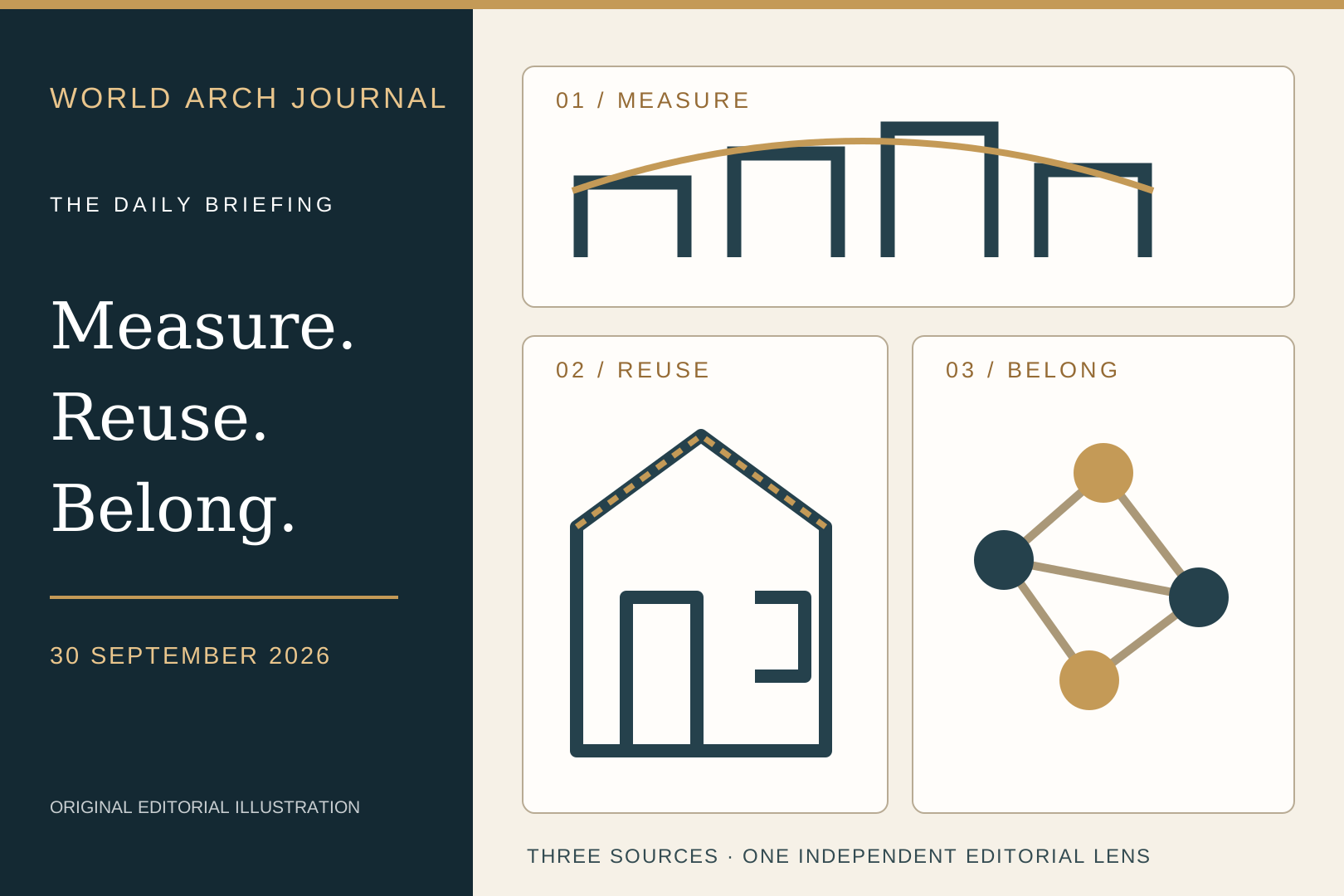
This issue draws on material published on 28–29 September 2026 and checked on 30 September. Each item links directly to its source and states that source’s publication date. A project year or award year is not treated as the news publication date. “Our reading” is independent editorial interpretation, not on-site reporting or verification of performance. Estimated reading time: five minutes.
01 / AIA asks what the 2030 numbers really measure
Source published:
The American Institute of Architects released its 2030 Commitment By the Numbers annual report on 28 September. It analyses participating firms’ 2025 design data and says 67% of reported whole-building projects were energy modelled. AIA also says reported energy reductions declined, in part because firms are moving toward their own baselines rather than older reference values. The result is a reminder that changes in the method can change the headline figure; this is not a measured outcome for every completed building.
Read source: AIA — 2030 Commitment By the Numbers, 28 September 2026
02 / In Quito, a published renovation makes retention visible
Source published:
ArchDaily published Feliu Vega Kennedy Arquitectura’s Fuente de Piedra #45 in Quito on 29 September. The project entry lists a 216-square-metre residential renovation with 2026 as its project year. In a description supplied by the architects, the team says it kept the townhouse complex’s external shell while opening the interior with slab cuts and skylights; it also describes salvaged parquet and an upper-level roof carried at the perimeter. The 29 September date is the publication date of this account, not a verified completion or opening date.
Read source: ArchDaily — Fuente de Piedra #45 project publication, 29 September 2026
03 / Student interiors frame care as spatial infrastructure
Source published:
Middlesex University reported on 29 September that two of its Interior Architecture students received Interior Educators National Student Awards 2026. Rachel Koh’s award-winning proposal brings support for new parents into a community hub with care, learning and gathering spaces. Nicoleta Mereuta’s proposal addresses social and wellbeing needs around London’s barge communities through a reimagined canal-side setting. These are student design proposals recognised by an awards programme, not completed public facilities.
Read source: Middlesex University — Interior Architecture student awards, 29 September 2026
The editor’s question: what survives the image?
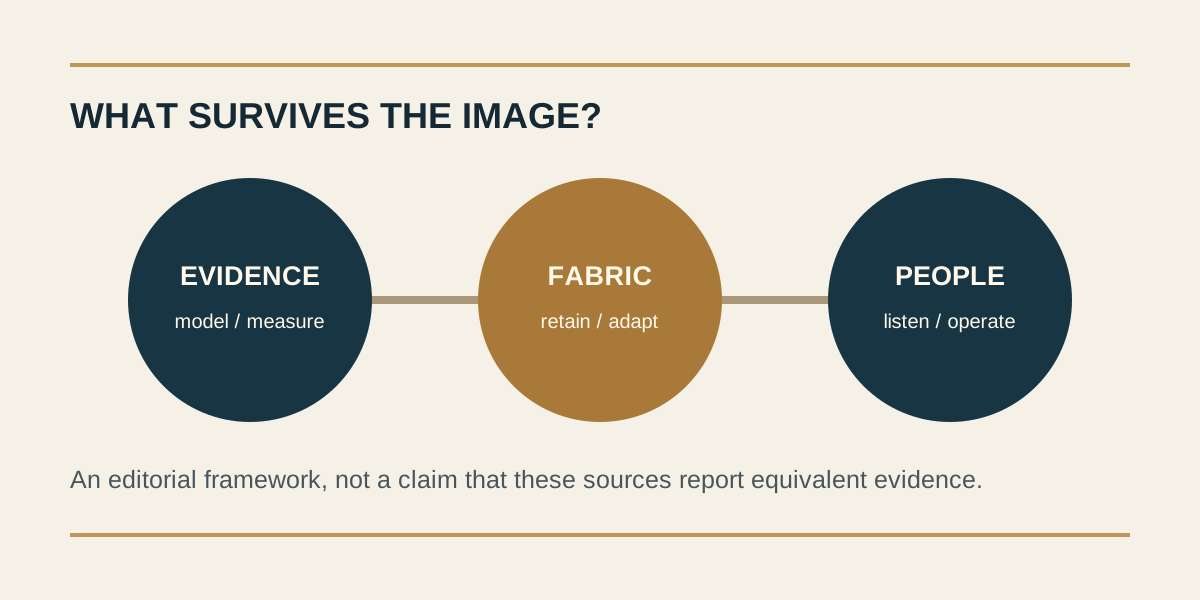
These stories are different in scale and evidence. An AIA data report concerns a participating design cohort, a project publication describes an architect’s renovation, and a university announcement presents unbuilt student work. Placing them beside one another does not make their claims equivalent. It asks a useful shared question: what evidence would show that an architectural intention benefits people and places after the first image?
Further reading
- Our original guide to adaptive reuse and what to retain
- Read the urban heat design article with its original editorial visual
- Explore our separate architecture analysis archive
- Previous edition: 29 September — Architecture Beyond the Object
- Next edition: 1 October — Who Gets Space, and Who Gets to Use It?
- Read our EPD guide to low-carbon concrete
- Passive house or net zero? Read the comparison
Source notes
Official announcements, source reporting and World Arch Journal commentary are distinguished. No sponsored placement is included in this edition.
Found an error or rights concern? Contact the publisher.
📌 Never miss a story — add World Arch Journal as your preferred source on Google: https://www.google.com/preferences/source?q=worldarchjournal.com