Low-Carbon Concrete: 7 EPD Checks for Architects
A low number is useful only when its boundary is clear. This seven-check method helps architects compare concrete EPDs fairly and carry a carbon target from concept to delivery.
By World Arch Journal ·


Project file
- FORMAT: Evidence-led international specification guide
- PRIMARY KEYWORD: Low-carbon concrete EPD
- SEARCH INTENT: Comparison · specification · embodied carbon
- EDITORIAL LEAD: World Arch Journal
- PUBLISHED: 7 October 2026
- VISUAL MIX: 2 original AI-assisted illustrations · 3 original diagrams
“Low-carbon concrete” is not one recipe and an Environmental Product Declaration is not a universal scorecard. An EPD reports environmental information for a stated product, unit, geography, time period and set of life-cycle modules. It can make procurement more transparent, but it does not automatically prove that one mix is structurally equivalent, locally available or lower impact across an entire building.
The distinction matters more in 2026. The Global Cement and Concrete Association has introduced global low-carbon ratings that classify concrete by reported global-warming potential and strength. The framework is a useful common language, yet the design team still has to compare like with like, protect technical performance and document what was actually supplied. The seven checks below turn a marketing claim into a reviewable architectural decision.
The quick answer
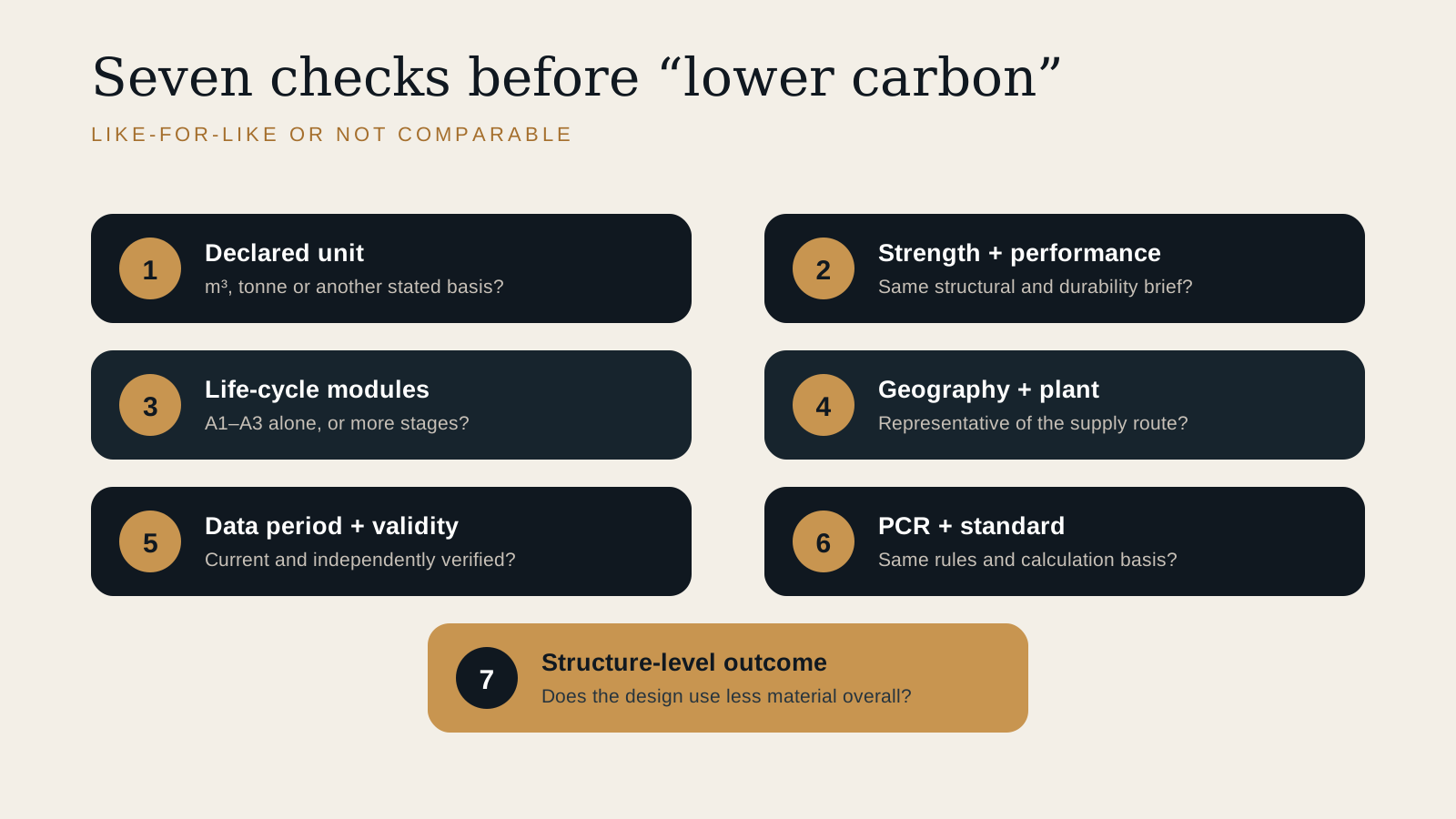
| Check | What the EPD may establish | What it cannot establish alone |
|---|---|---|
| Declared unit | The basis for the reported result, often kg CO₂e per m³ for concrete | That two differently defined results are comparable |
| Strength and performance | The product or family covered by the declaration | That the mix meets the project’s structural, durability and finish brief |
| Life-cycle modules | Which stages are included in each reported value | Impacts outside the declared boundary |
| Geography and plant | The production data and market represented | The exact delivery distance or site practice unless those are included |
| Verification and validity | Whether the declaration follows a programme and third-party review | That the document is current for the supplied product |
| Calculation rules | The standard and product-category rules used | Direct comparability when rules or assumptions differ |
| Whole structure | A product-level input for life-cycle assessment | Whether the building uses the least material for the required service |
1. Match the declared unit
Start with the denominator. Ready-mix concrete is commonly reported per cubic metre; cement may be reported per tonne. A project team can create a dramatic but meaningless comparison by placing those values in the same spreadsheet without conversion. Even two cubic-metre values may describe different product families, production averages or characteristic strengths.
Write the comparison basis at the top of the schedule before collecting numbers. For concrete, that basis should normally identify volume, specified strength, exposure or durability requirements, intended application and the life-cycle modules being reviewed. If a supplier offers only a broad industry-average EPD, label it as such. Product-specific and plant-specific declarations may provide more relevant evidence, but only when the actual order matches their stated coverage.
The GCCA’s 2026 rating system is helpful because it uses global-warming potential in kilograms of CO₂ equivalent per cubic metre and evaluates it in relation to concrete strength. It does not remove the need to read the declaration. A rating simplifies communication; the EPD and project records provide the audit trail.
2. Hold strength and performance constant
Carbon should not be lowered by quietly changing the job the material must do. Compare alternatives that satisfy the same verified structural, fire, durability, workability, curing and architectural-finish requirements. A mix for a lightly loaded internal element is not a fair benchmark for a marine exposure, a transfer structure or a fast-cycle precast operation.
At the same time, do not freeze unnecessary constraints. Very high early strength, narrow cement-content limits, an assumed percentage of supplementary cementitious material or a cosmetic colour requirement can reduce the supplier’s room to optimise a mix. MECLA’s low-carbon concrete guide recommends setting an embodied-carbon target while maintaining technical performance, and warns against relying only on a prescribed percentage of cement replacement. That is a useful international principle even though its compliance references are Australian. Embodied carbon is, after all, only one side of the ledger that net zero architects must balance against operational energy.
The best specification separates outcomes from means. State the required performance, define the carbon metric and boundary, then invite compliant proposals. Let the structural engineer, contractor and supplier review programme and testing implications early enough for trial mixes. A lower-carbon option discovered after the formwork cycle has been fixed may be rejected because the programme cannot absorb a different strength-development curve.
3. Read the life-cycle boundary
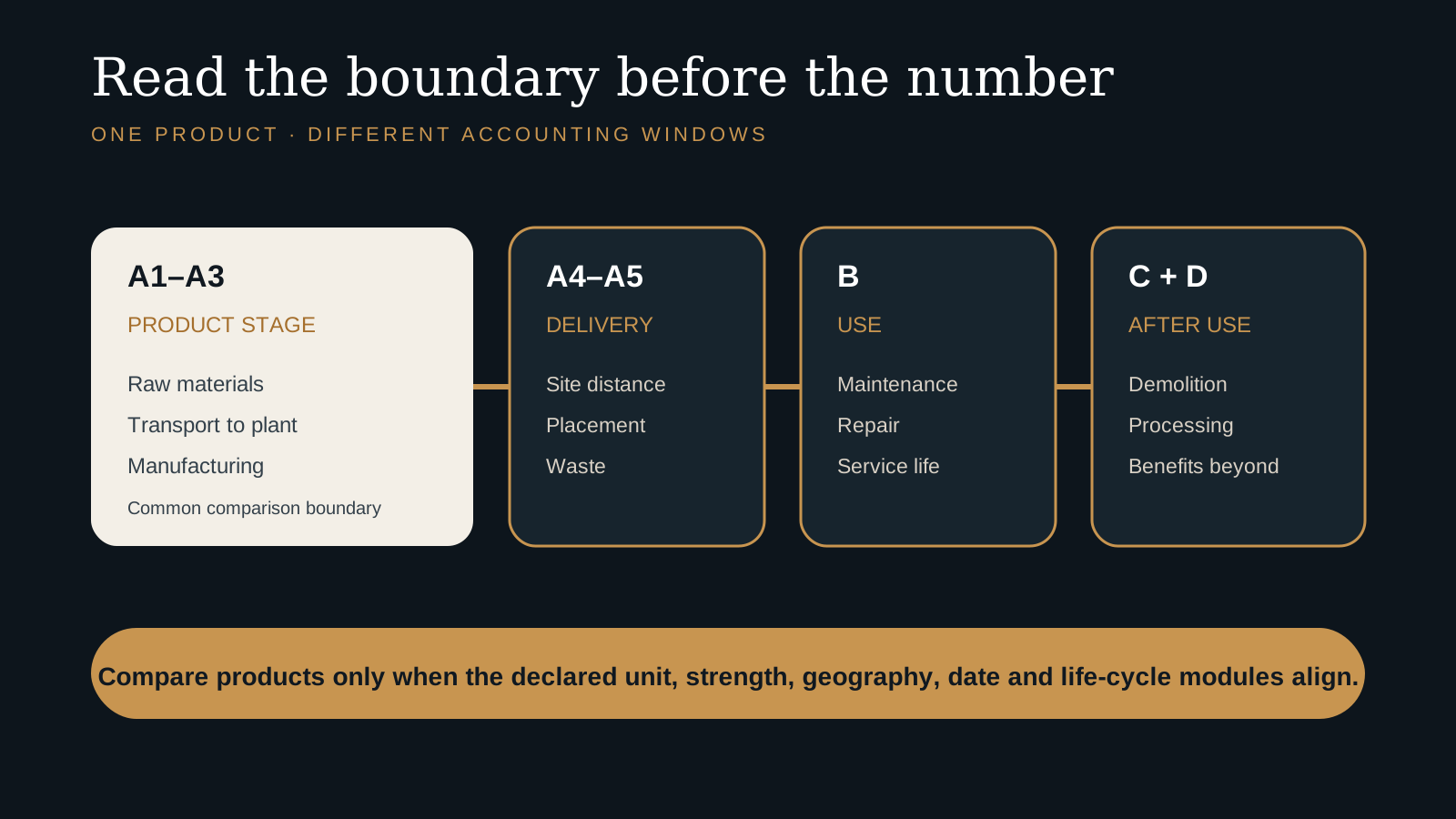
The headline global-warming-potential number may cover only product stages A1–A3: raw-material supply, transport to manufacturing and manufacturing. Another declaration may also report transport to site, construction, use, demolition, waste processing or potential benefits beyond the system boundary. Adding unlike columns produces false precision.
For an early product comparison, A1–A3 can be a disciplined common boundary. It captures major production impacts and is often the most consistently available dataset. But it is not the whole project. A distant mix with a good plant-stage result may lose part of its advantage through delivery. Waste, temporary works, rejected loads, curing, service life and end-of-life assumptions can also matter.
Record each module separately rather than merging everything into one unlabelled number. If a study uses A1–A5, say so every time the result is shown. If module D is reported, keep it visible as a scenario beyond the product system rather than automatically subtracting a future benefit from present emissions. The boundary diagram below is deliberately qualitative: the correct numerical scope depends on the project, methodology and jurisdiction.
4. Check geography, plant and supply route
Concrete is local in a way that many finish products are not. Aggregate sources, cement chemistry, electricity, transport, plant efficiency and available supplementary materials vary by region. An EPD based on a national average may be suitable for a concept baseline but weak evidence for a plant-specific procurement claim.
Ask four direct questions: Which plant or plants are represented? What production period underlies the data? Does the product family include the proposed mix? How will the delivery distance and mode be treated? If the answer changes between tender and construction, the carbon calculation should change too.
Regional availability is not a footnote. MECLA notes that achievable reductions can vary between metropolitan and remote areas and between ordinary and specialist applications. A responsible target therefore combines ambition with a documented market test. The point is not to excuse a high-impact option; it is to prevent a global benchmark from becoming an impossible local instruction.
5. Verify date, programme and third-party status
An EPD has a publication date, validity period, programme operator and verification statement. Confirm all four. A polished PDF hosted on a product page is not necessarily current, independently verified or applicable to the item being ordered. Save the exact declaration used for the decision rather than only a hyperlink that may later change.
Look for the declared standard, product-category rules, verifier, registration number and expiry date. Check whether the document is product-specific, plant-specific, manufacturer-average or industry-average. None of those categories is inherently dishonest; they simply answer different questions. Label the evidence correctly in the design model and tender return.
At handover, reconcile the proposed product with delivery tickets, approved substitutions and final quantities. The design-stage EPD remains useful, but it should not be presented as an as-built result if the supply changed. Evidence quality is part of the architecture because it connects the published intention to the physical material.
6. Check the standard and calculation rules
EPDs are produced under standards and product-category rules that define data, allocation and reporting conventions. Two valid declarations can still differ in ways that limit direct comparison. Review whether the same generation of rules, indicators and module definitions has been used. Where the programme operator provides comparison guidance, follow it.
Biogenic carbon, carbonation, recovered fuels, recycled content, allocation of industrial by-products and end-of-life scenarios can be treated differently across datasets and standards. Concrete also absorbs some carbon dioxide through carbonation over time, but that process does not erase production emissions. If a claim includes uptake, state the method, timing and life-cycle module; do not convert it into the phrase “carbon neutral” without a complete, verified basis.
Architects do not need to become life-cycle-assessment auditors, but they do need to recognise a boundary mismatch and involve a competent specialist when the decision is material. The same discipline applies across the mass-timber specification process: a material label is less useful than a transparent, comparable dataset.
7. Test the whole structure, not only the mix
A lower-impact cubic metre can still create a higher-impact building if the design needs substantially more of it. Conversely, a higher-strength or post-tensioned system may use less total concrete and produce a lower structural total. MECLA makes this distinction directly: the real aim is a low-carbon structure, not merely a low-carbon product.
Begin with the highest-leverage questions. Can an existing structure be retained through adaptive reuse? Can spans, grids, loads or basement depth be reduced? Can the same brief be met with less floor area or fewer transfer elements? The AIA–Carbon Leadership Forum toolkit places reuse, building less, lighter design, material substitution and lower-carbon procurement in a sequence for good reason. Product optimisation should follow, not distract from, structural efficiency.
Measure both intensity and quantity. Track kilograms of CO₂ equivalent per declared unit, but also multiply by realistic quantities and compare complete structural options. Keep structural service life, robustness and future adaptability in view. A small numerical win that shortens service life or makes future change impossible is not automatically responsible.
Turn EPD evidence into procurement
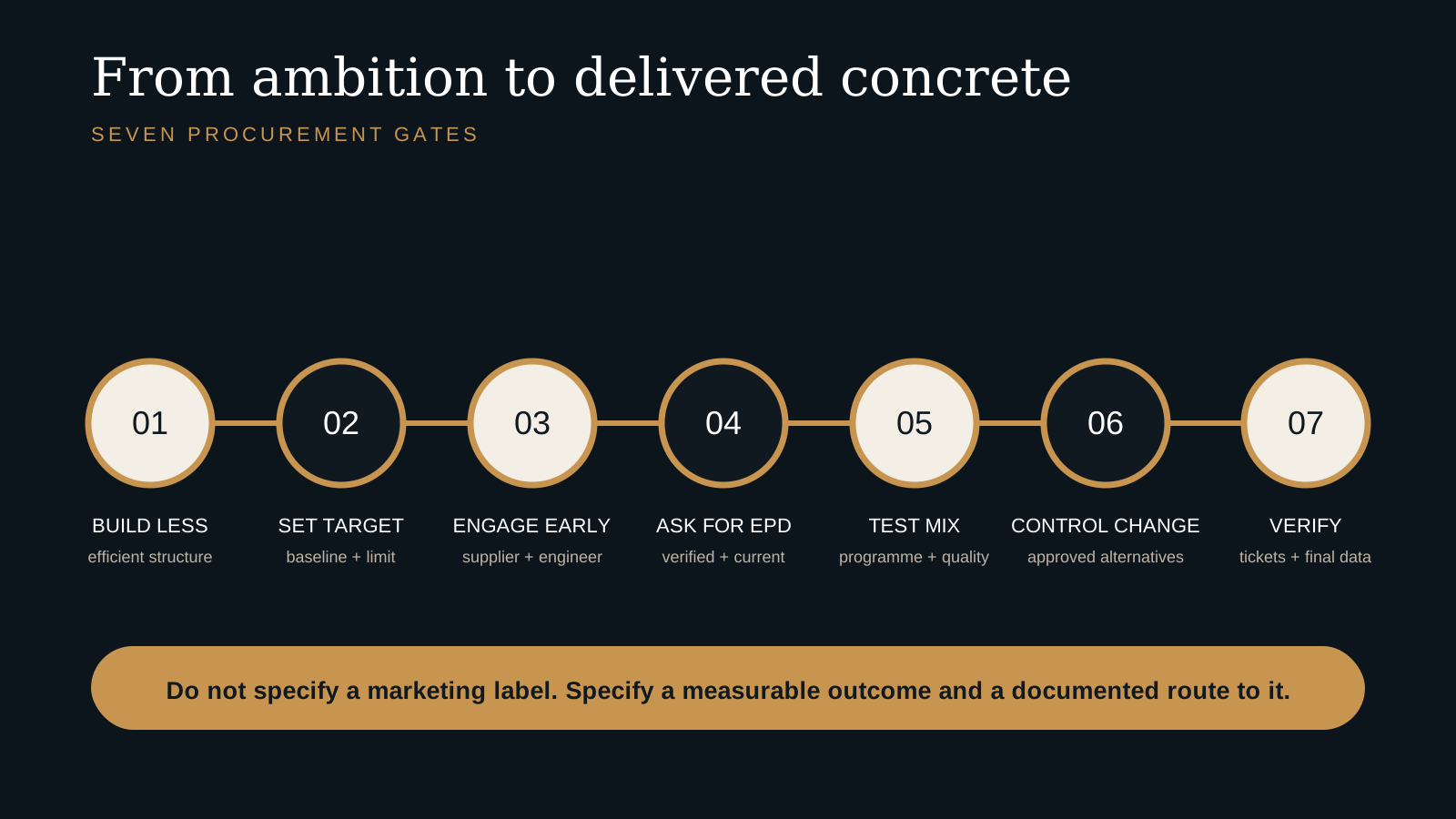
The most credible low-carbon concrete strategy is a chain of decisions rather than a paragraph in a sustainability report. Establish a baseline at concept stage. Set a project-specific limit or reduction target with the structural and life-cycle teams. Market-test it with suppliers. Define acceptable evidence and the procedure for substitutions. Allow trial mixes and mock-ups where appearance, finish or programme is sensitive.
During tender, request the EPD, proposed plant, mix reference, declared unit, strength class, relevant durability characteristics, life-cycle modules and stated GWP. Ask bidders to identify assumptions rather than hide them. During construction, require approval before a change to plant or mix and keep records of delivered quantities. At completion, distinguish design, tender and as-built results.
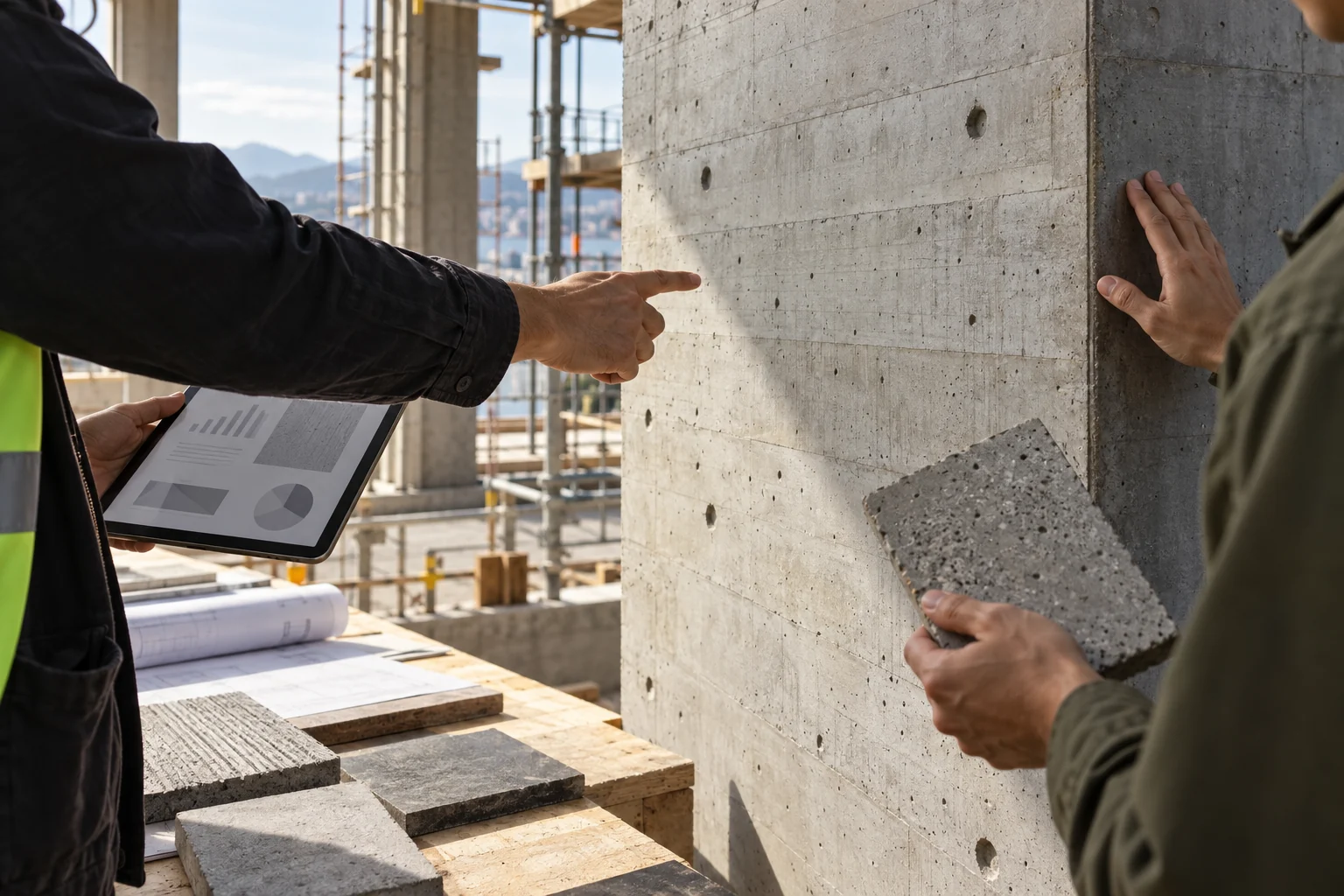
The site photograph in this feature is an editorial illustration, not proof of a specific product. It shows the real coordination problem: a surface, sample, structural requirement and carbon dataset have to agree. The same approach should be carried into the project’s BIM information workflow without turning a provisional figure into a fixed truth.
A one-page architect’s low-carbon concrete brief
- Define the element and outcome. Record application, quantity, structural and durability requirements, finish and programme.
- Set the comparison basis. State declared unit, life-cycle modules, strength and geographic relevance.
- Establish the baseline. Name the dataset, date and assumptions; do not use an invisible “typical mix.”
- Set a measurable target. Use a maximum GWP or project reduction method reviewed by the responsible specialists.
- Request verified evidence. Require a current EPD and confirm its programme, scope and product coverage.
- Engage the supply chain early. Test availability, trial-mix needs, curing, finish, cost and programme.
- Protect the target through change. Define how substitutions are evaluated and approved.
- Reconcile delivery. Use final quantities and accepted product records to report the as-built position honestly.
The useful question is not “Is this concrete green?” It is: lower than what, for the same job, across which boundary, based on whose verified data, and was that product actually delivered? When those answers stay attached to the number, an EPD becomes a design and procurement instrument rather than a badge.
Continue exploring: specification numbers only matter when they reach the drawing — our 30 September briefing is devoted to measuring what buildings claim, and the material library publishes the surface data behind our own product studies.
From the library: Concrete was already an architectural material two thousand years ago — read Ancient Rome, Book XX of the Architectural History Series, free to read online, on the builders who cast it at imperial scale.
Frequently asked questions
Does an EPD prove that concrete is low carbon?
No. An EPD reports impacts for a defined product and boundary. A low-carbon claim still requires a fair baseline, like-for-like performance, relevant geography and a transparent comparison method.
Can two concrete EPD numbers be compared directly?
Only when key conditions align, including declared unit, strength and performance, life-cycle modules, calculation rules, data period and geographic relevance.
Should architects specify a cement-replacement percentage?
A prescriptive percentage may restrict viable solutions. Many teams instead set a verified embodied-carbon outcome while retaining all technical requirements, then work with the engineer and supplier on the mix.
Is the lowest GWP per cubic metre always the best structural choice?
No. Total material quantity, structural efficiency, service life, programme and performance also matter. Compare complete structural options as well as product intensity.
What is an EPD (environmental product declaration)?
A standardised, third-party-verified report of a product environmental impacts across stated life-cycle stages, prepared under shared product category rules. For concrete it is the document behind any low-carbon claim — which is why this guide reads it through seven checks before trusting the headline number.
What does GWP mean in a concrete EPD?
Global warming potential: the climate impact of the declared unit, expressed in kilograms of CO2-equivalent. In most concrete EPDs the production stages dominate it, which is why cement content, replacements and transport distance matter — and why GWP per cubic metre must still be read against the whole structure, as the checks above show.
Evidence and source notes
- Global Cement and Concrete Association — Introduces 2026 global low-carbon ratings for concrete based on GWP per cubic metre and concrete strength, using EPD-reported data.
- Materials and Embodied Carbon Leaders’ Alliance — Recommends verified EPDs, outcome-based targets, early supply-chain engagement and whole-structure thinking.
- AIA and Carbon Leadership Forum — Organises embodied-carbon reduction strategies around reuse, building less, system choices, procurement and measurement.
- NSW Government — Provides a worked public-sector approach to lower-carbon concrete requirements and procurement guidance.
- Global Cement and Concrete Association EPD Tool — Explains EPD generation, verification and use for cement and concrete reporting.
- International Energy Agency — Tracks cement-sector emissions and decarbonisation pathways in the wider energy transition.
Related architecture stories
- Carbon Budgets for Buildings: How Architects Set a CO₂ Target and Hit It
A carbon budget treats a building's CO2 like its construction budget: fixed early, tracked relentlessly, and defended against every design change. How architects set the number, calculate it, and hit it.
- Insulating Solid Walls from Inside: Breathable Materials, Damp Risks and What It Costs
Internal wall insulation works when the wall is dry, the vapour strategy matches the masonry, junctions are detailed and ventilation is improved at the same time.
- Can Data Centres Be Good Architecture?
Data centres are disliked for their water use, energy hunger, noise and blank facades. This guide separates real engineering constraints from design habits — and shows what good architecture looks like, from Stockholm's bunker data centre to Nordic heat reuse.
📌 Never miss a story — add World Arch Journal as your preferred source on Google: https://www.google.com/preferences/source?q=worldarchjournal.com